
The first recipe I built without a tutorial was 70 percent olive oil, because I thought more olive meant a gentler bar. It unmolded like cold pudding and took nearly 5 months to firm up into a usable Castile, and for the first few weeks I was sure I had wasted the whole batch.
How I learned to build my own soap recipes
My worst formulating mistake came a year later, and it was faster and more painful than the soft Castile. I swapped the olive oil in a working recipe for rice bran to use up a bottle, kept the same lye weight out of laziness, and never re-ran the numbers. The new oil needed less lye, so the finished bars came out lye-heavy, rough, and slightly stinging on wet skin. I lost a 900 g batch and spent an evening rebatching the salvageable part.
Lye does not forgive a guess. Each oil saponifies with its own amount of sodium hydroxide, so reusing an old lye figure with a new oil is the quickest way to make a caustic bar that can irritate skin.
Those two failures taught me what formulating actually is. Building a recipe is deciding what a bar should feel like, then choosing oils and a lye amount that deliver it, with a calculator checking the chemistry before I ever reach for the blender.

What building your own recipe really involves
Formulating soap means picking a blend of fixed oils and fats, then setting the sodium hydroxide and water that turn them into soap through saponification. Soapmakers also call this working from a lye calculator or running the numbers, and the practice grew out of the old trade of soap boiling once reliable lye purity made exact math possible. Follow a printed recipe and you are a cook. Build your own and you are formulating, which is a different and slower skill.
The core abilities are small in number but strict. You need to read oil properties, weigh by mass, set a sensible superfat, and run every version through a calculator before mixing. None of that is hard on its own, and the difficulty is in respecting the order every single time.
Each base oil pushes the bar toward a quality: coconut adds cleansing and big bubbles, olive adds mildness and long life, hard fats like palm or lard add firmness, and castor boosts lather. A recipe is a balance between these pulls, not a single hero oil.
This suits a patient beginner who has already made a batch or two from a set recipe. Jumping straight to formulating without that base tends to hide which variable caused a problem. Compared to melt and pour, where you scent a ready base, building a cold process recipe gives full control of feel and cost, and full responsibility for the lye math.
Do you know what you want the finished bar to do before you pick a single oil? A recipe built to be hard and cheap will feel nothing like one built to be mild and slow-lathering.
There are a few guardrails worth internalizing early. Keep coconut oil at or below 30 percent in a skin bar, or it turns harsh and stripping. A bar heavy in soft oils like olive will trace slowly, take longer to harden, and cure for months rather than weeks.
Have you ever swapped one oil for another and kept the same lye amount? That single shortcut is behind a large share of lye-heavy first batches, including one of mine.
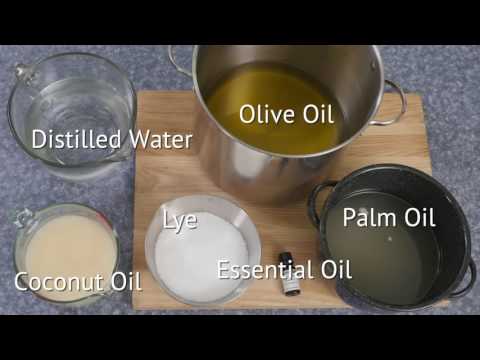
Oils and tools you actually need
You do not need a big pantry to formulate well, and three or four oils cover most skin bars. What matters is knowing the job each one does and having a scale accurate enough to trust.
| Item category | Specifications |
|---|---|
| Coconut oil | Cleansing and lather; use up to 30 percent in a skin bar |
| Olive oil | Mild and conditioning; can run 30 to 45 percent, cures very hard |
| Hard fat (palm, lard, or tallow) | Firmness and stable lather; roughly 20 to 30 percent |
| Castor oil | Boosts bubbly lather; keep to 3 to 8 percent |
| Butter (shea or cocoa) | Creamy feel and hardness; 5 to 15 percent, optional |
| Sodium hydroxide (NaOH) | Lye for cold process; weight set by your oils and superfat |
| Distilled water | 30 to 38 percent of oil weight, or set by lye concentration |
| Digital scale | 0.1 g resolution; formulating fails without accurate weights |
| Stick blender and thermometer | For bringing the batch to trace at 38 to 43 C |
Set your superfat before anything else, since it changes the lye figure. A 5 percent superfat leaves a small cushion of unsaponified oil that both conditions skin and covers small measuring errors. Move it to 6 to 8 percent for a facial bar, and expect a softer result.
Once your oils and superfat are chosen, a lye calculator takes the oil weights and target superfat and returns the exact sodium hydroxide and water for the batch.
Loading calculator...
Skills to build a recipe from scratch
- Decide the bar’s purpose first: gentle, cleansing, hard, or cheap, since that guides every oil choice.
- Pick two or three base oils and set each around 20 to 30 percent of total oils.
- Add castor at 3 to 8 percent when you want more lather, and no higher.
- Set a superfat, starting at 5 percent for a general bar.
- Choose a water amount, commonly 30 to 38 percent of oil weight, using more for working time and less for faster hardening.
- Run the full recipe through a lye calculator every time, and re-run it after any oil change.
- Check the estimated bar qualities and treat them as a guide, since real bars sometimes defy the numbers.
- Test an unfamiliar oil in a single-oil batch to learn how it behaves alone.
- Bring oils and lye solution together near 38 to 43 C and blend to a light trace.
- Record the exact recipe, weights, and dates so a good result can be repeated.
Common mistakes and how to avoid them
- Swapping oils without re-running the math. Every oil has its own lye requirement, so recalculate after any change, even a small one.
- Overloading soft oils. A recipe above 60 percent olive or other soft oils stays soft and can take 4 to 6 months to cure, as a 100 percent olive Castile does.
- Too much coconut oil. Past 30 percent in a skin bar it strips the skin, though 100 percent coconut works for laundry soap at a 20 percent superfat.
- Skipping the superfat. With superfat at 0 percent any measuring error can leave excess lye, so hold at least 5 percent for a skin bar.
- Measuring by volume. Formulating runs on mass, and a cup of one oil weighs differently than a cup of another, so weigh everything in grams.
- Adding an untested fragrance to a full batch. Some fragrance oils speed up trace and seize the batter, so test a small amount before scaling.
Treat calculator bar-quality numbers as a starting point, not a verdict. I have made bars that scored plainly on paper and performed beautifully, and others that looked ideal and crumbled in the shower.
Formulating a balanced beginner bar
Here is a starting recipe I hand to people who want to formulate their first bar. Set it as percentages of total oil weight: 30 percent coconut, 35 percent olive, 25 percent palm or lard, 5 percent shea butter, and 5 percent castor. Use a 5 percent superfat and water at about 33 percent of oil weight.
That blend gives a firm bar with steady lather and a mild feel, and it unmolds in about 24 hours. Once you have made it, change one thing at a time: raise coconut for more bubbles, lift olive for mildness, or drop water for a faster set. Single changes teach you what each oil does far better than rebuilding the whole recipe at once.
Change one variable per batch and log the result. Within five or six batches you will have a personal map of how each oil shifts hardness, lather, and cure time, which no chart can fully give you.
Before mixing a new blend, the oil blend properties calculator estimates hardness, cleansing, conditioning, and lather from your oils and percentages, so you can judge the recipe on paper first.
Loading calculator...
Final thoughts
Formulating your own soap is a slow skill with a fast payoff once it clicks. The chemistry sets hard limits, and inside those limits there is real room to design a bar that fits your skin and your budget. If you already understand a base recipe and you respect the lye math every time, building your own is where soap making becomes genuinely yours.
What I would tell my earlier self is to trust the calculator over the instinct. My soft Castile and my lye-heavy rice bran batch both came from ignoring numbers I could have checked in two minutes. Weigh carefully, recalculate after every change, and let the bar teach you the rest over a few honest batches.








Buying bulk coconut oil at Costco or even local Asian grocers saves so much compared to craft store prices. I usually grab a 3 quart tub for around 12 dollars. My main concern is the lye cost, which adds up with shipping. Is there a way to scale these recipes without ending up with 20 bars that take up shelf space? I hate having leftover oil sitting around for months. Using basic fats like lard from the grocery store aisle works for me, but I worry about the final feel. Does replacing fancy butter with lard change the cost significantly?
Regarding scale and cost, lard is an excellent alternative to shea or cocoa butter for hardening a bar, and it is significantly cheaper per ounce. When you swap in lard, you do not need to adjust the lye amount drastically because its saponification value is quite close to tallow, though you must still verify it in a calculator. To manage batch sizes, simply set your calculator to output a 500 gram total oil weight. This yields about 5 standard bars, which prevents overstocking. Shipping costs for lye are often high due to hazard fees, so sourcing from a local supplier who stocks caustic soda for water treatment or soapmaking can eliminate that expense entirely.
That makes sense. I will try the 500 gram batch size next time. Is the lye-water concentration still safe at that small volume?
Yes, the lye-water concentration remains entirely safe at that volume. Just ensure you use a container rated for high-pH solutions, such as heavy-duty polypropylene, to handle the heat of the reaction safely.
I never mix my lye solution without a dedicated digital scale that reads to the 0.1 gram increment. Cheap kitchen scales just do not have the sensitivity required for accurate saponification math. My Ohaus Scout scale is the backbone of my studio, and I calibrate it with a 500 gram weight every single week. People often overlook the importance of a high-shear stick blender as well. I use a Braun MultiQuick 7 for my emulsions. It handles heavy trace without overheating the motor. Proper tool maintenance means cleaning the blade housing immediately after use. Do you notice a difference in the gel phase when using high-end stainless steel immersion blenders versus the basic plastic ones from the drugstore?
About the equipment, the power of the motor in a high-end immersion blender certainly affects the speed of reaching emulsification. A stronger motor creates a more consistent emulsion, which helps prevent oil separation during the initial stages of saponification. Using a high-shear tool allows you to work at slightly lower temperatures, which is useful for delicate formulations. While a professional-grade tool does not change the chemistry of the lye reaction itself, it offers better control over the texture and the timing of the trace. Maintaining a clean blade housing is the most important step for longevity, as caustic residue will corrode the metal components and eventually cause internal motor damage if it leaks past the shaft seal.