My first from-scratch liquid soap zapped my tongue after four hours in the crockpot, and I could not figure out why until I reread the label on my lye. Liquid soap runs on a different alkali than bar soap, and that one difference reshapes the entire process. A good batch rewards you with a clear, pourable soap you can tune for hands, dishes, or body.
What liquid soap taught me about reading the label
That first batch was a math error. I ran the recipe at a 5 percent superfat and assumed my potassium hydroxide was pure, when the flakes were only 90 percent. The paste stayed lye-heavy through four hours of cooking, dried out, and I tossed an afternoon of work along with a batch of coconut and olive oil.
The recalculation fixed everything. Once I accounted for the purity and dropped the superfat, the next paste cooked clean and diluted into a soap I still make. Precision at the calculator is where liquid soap is won or lost.
Liquid soap from scratch uses potassium hydroxide, also called caustic potash, rather than the sodium hydroxide used for bars. KOH produces a soft, water-soluble soap that stays a sticky paste instead of hardening into a block. Dissolve that paste in water and you get liquid soap. It is a genuinely different craft from watering down a premade castile, which involves no lye at all.
I cook my paste hot process in a slow cooker, the same tool I use for hot process bars. The potassium hydroxide is what changes the outcome, turning a hard bar recipe into a dilutable paste.
What this craft really entails
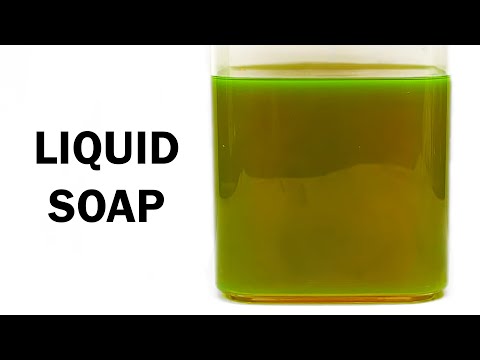
Making liquid soap has two phases. First you cook a soap paste by saponifying oils with potassium hydroxide, the same way you would a hot process bar. Then you dilute that paste with water over several hours until it becomes a pourable liquid.
People also call it potash soap or soft soap, and it is the ancestor of every bottle of hand wash on a shelf. Oil choice matters more here than for bars, because clarity is part of the goal. Coconut oil at 40 to 60 percent drives lather and helps the soap stay clear, while olive oil conditions but turns the soap cloudy if you use too much. Castor oil adds lather and clarity.
The core skills are accurate lye calculation, reading the paste through its cooking stages, and dialing in the dilution. None of it is beyond a determined beginner, though the whole thing takes patience that bar soap does not demand.
Have you cooked a paste for four hours and still gotten zapped on the tongue? That usually means the recipe did not account for KOH being only 90 percent pure, so the batch ran lye-heavy from the start.
Liquid soap suits someone comfortable with lye who wants hand or dish soap they can customize, and who does not mind a project that spans an afternoon. Compared to a cold process bar, it asks for more cooking time and a dilution step. Compared to diluting a premade castile in a pump, it asks for real soapmaking, and it gives back full control over the oils and scent.
Two questions separate a clear batch from a cloudy one. Did your finished soap turn milky instead of translucent? And is your KOH 90 percent pure or 95, and did your recipe account for it? Both trace back to the calculator and the oils, and both are covered below.
Essential materials and tools
A batch fills several bottles and keeps well, since true soap runs at a high enough pH to resist spoiling. Amounts scale with your slow cooker size.
| Item Category | Specifications |
|---|---|
| Potassium hydroxide (KOH) | Caustic potash, usually 90 percent pure; check the label and calculate for that purity |
| Oils | Coconut at 40 to 60 percent, olive at 20 to 30 percent, plus castor for lather and clarity |
| Distilled water | About 3 times the KOH weight for the lye solution, plus more for dilution |
| Slow cooker | 4 quart crockpot with no nonstick or Teflon coating, which reacts with lye |
| Stick blender | Immersion blender to bring the batter to a thick trace |
| Digital scale and thermometer | Scale accurate to 1 gram, thermometer to keep the cook below 185 F |
| Safety gear | Nitrile gloves, splash goggles, long sleeves; KOH fumes and pops when it hits water |
| Vegetable glycerin | Optional, added during dilution for clarity and a gentle superfat |
| Fragrance and bottles | Skin safe fragrance or essential oil; pump or foamer bottles for packaging |
The lye calculator below takes your oil weights, with KOH selected and the purity set, and returns the potassium hydroxide and water for your paste. Run every recipe through it and set a low superfat before you weigh anything.
Loading calculator...
Key techniques and skills
- Running the recipe through a lye calculator set to KOH, with purity set to 90 percent
- Choosing clarity-friendly oils, coconut heavy with modest olive
- Keeping the superfat low, between 1 and 3 percent
- Mixing about 3 parts water to 1 part KOH for the lye solution
- Adding KOH to water, never the reverse, in a ventilated spot
- Stick blending the batter to a thick, pudding-like trace
- Cooking the soap paste on low, covered, and below 185 F
- Reading the paste stages: separation, applesauce, taffy, vaseline, done
- Testing doneness by dissolving a piece in hot water and checking clarity
- Diluting the paste with distilled water at about 1 to 1, thinner for foamers
- Stirring in glycerin during dilution for clarity and a gentle superfat
- Cooling fully before adding fragrance, then bottling in a pump or foamer
The clarity test is how I know the cook is finished. I dissolve a pea sized piece of paste in a spoon of boiling water and look at it. Clear means the paste is done and safe to dilute, while cloudy means unsaponified oil remains and it needs another half hour. It beats guessing by the paste’s look alone.

Common mistakes and how to avoid them
- The paste still zaps after four hours. Cause: KOH purity not accounted for, or too high a superfat. Fix: recalculate for 90 percent purity and a 1 to 3 percent superfat, and cook until a hot-water sample runs clear.
- The finished soap is milky and cloudy. Cause: too much olive oil or too high a superfat. Fix: shift toward coconut, drop the superfat to 1 to 3 percent, and stir glycerin in during dilution.
- The paste foams and climbs the crockpot. Cause: the cook ran above 185 F. Fix: keep the slow cooker on low and turn it down if the temperature climbs.
- An oily layer floats on the diluted soap. Cause: superfat too high, leaving unsaponified oil to separate. Fix: lower the superfat next batch, since a well-cooked paste near 2 percent stays uniform.
- The soap comes out too thin or too thick. Cause: the dilution ratio was off. Fix: start at 1 part paste to 1 part water, and go thinner, near 1 to 2, for a foamer bottle.
Potassium hydroxide deserves the same respect as any lye. Add it to the water and never water to it, work in a ventilated space, and wear goggles and gloves, because KOH pops and gurgles as it dissolves and gives off fumes you should not breathe. The solution heats quickly the moment the flakes hit the water.
Three points decide whether your soap turns out clear and safe. Liquid soap needs potassium hydroxide, not the sodium hydroxide used for bars, since KOH makes a soft paste that dissolves in water. Keep the superfat at 1 to 3 percent, because extra unsaponified oil clouds the finished soap and can float as an oily layer. And test the paste by dissolving a piece in hot water, where clear means done and cloudy means cook longer.
From paste to bottle, step by step
Here is how a batch runs in my kitchen. I melt the oils in the slow cooker on low, mix the KOH into three times its weight of water, and pour that solution into the oils once both are warm.
Then I stick blend to a thick trace, cover the crockpot, and cook on low. The paste separates first, thickens through an applesauce look, pulls like taffy, and finally turns a smooth, translucent vaseline over about three to four hours, with a stir every half hour.
The payoff is a soap I can bend to any use. The same paste becomes a gentle hand wash at one dilution, a body wash with glycerin added, or a dish soap at a thinner ratio, all from one afternoon of cooking. No bottle on a store shelf gives me that range.
Once a hot-water sample runs clear, I add distilled water straight to the paste in the crockpot, roughly matching the paste weight, and leave it on low for several hours to dissolve. Stirring now and then helps, though it mostly takes patience.
The honest cost is time. A liquid batch ties up a slow cooker for most of a day between the cook and the long dilution, where a melt and pour bar is done in an hour. The finished soap also runs thinner than the commercial gels people expect, which takes some getting used to.
After the paste fully dissolves, I let the soap cool, then stir in fragrance, which may cloud it briefly before clearing within a day. From there it goes into pump or foamer bottles. The soap is thinner than store gel and thicker than water, exactly what real liquid soap looks like.
The dilution calculator below takes your paste weight and target consistency and returns how much water to add, so you hit hand-wash, body-wash, or foamer thickness without trial and error. Enter your paste amount and intended use to get the water figure.
Loading calculator...
Final thoughts
Liquid soap asks for careful lye math, a low superfat, and an afternoon of patience, and it gives back a customizable soap that a single paste can turn into three different products. Anyone comfortable handling lye can make it, though I would not pick it as a first soap project over a simpler bar. Start with a small coconut-heavy batch and check your KOH purity before you calculate.
What I would tell my earlier self is to read the lye label first and set the calculator to match. That one habit would have saved me a lye-heavy paste and a wasted afternoon. Keep the superfat low, hold the cook below 185 F, and trust the clarity test to tell you when the paste is truly done.