I started making my own foaming hand soap after a store bottle ran dry and I refused to pay eight dollars for a refill I could mix in two minutes. The bar next to my sink was already castile, so I figured I understood soap. My first attempt taught me otherwise, and now every sink in the house runs on a bottle I fill myself for pocket change.
Why I switched every sink to homemade foaming soap
My first batch was a small disaster. I grated a bar of castile, melted it in water, and poured the thick liquid into a foaming pump, where it promptly gelled and clogged the mechanism solid. I lost the bar, ruined a dispenser, and spent twenty minutes picking soap paste out of the pump tube before I gave up and bought a bottle of liquid castile instead.
The fix was simple once I understood the chemistry. Bar soap carries added sea salt that thickens the moment you dilute it, which is exactly wrong for a foaming pump. A foaming pump dispenser needs thin soap it can whip with air, so the whole method depends on starting from a liquid.
The pump itself does the foaming. Inside the head is a small mesh screen and an air chamber, and when you press down the mechanism forces a thin soap solution through the mesh together with air. That is why the soap has to be watery. A thick solution cannot pass the screen, and a standard lotion pump has no air chamber at all.
Once I had that straight, the recipe became almost too easy to call a recipe.
What this craft really entails
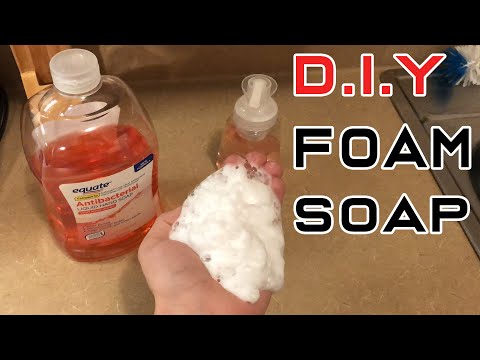
Foaming hand soap is liquid castile soap diluted with water in a pump built to aerate it. Castile is a plant oil soap, traditionally olive but often blended with coconut or castor oil, sold already saponified as a liquid. You are diluting a finished product, so there is no lye, no heat, and nothing to cure.
People sometimes call it DIY foaming soap or refillable hand soap, and the idea traces back to the simple practice of watering down concentrated soap to stretch it. The pump technology is what turned that thrift into a pleasant foam. Any liquid castile works, scented or plain, along with specialty liquid soap bases sold for the purpose.
The core skills are measuring a workable dilution ratio, adding ingredients in the right order, and choosing water that will not spoil. None of this is hard. The one judgment call is the ratio, since too much soap will not foam and too little feels like scented water.
Have you ever filled a bottle, pressed the pump, and gotten runny liquid instead of foam? Nine times out of ten the culprit is a standard pump rather than a foaming one, or a solution mixed far too thick.
It suits a complete beginner and takes about five minutes per bottle. Compared to making liquid soap from scratch, which means cooking a soap paste for hours and diluting it over days, this method skips straight to the fun. It also compares favorably to buying refills on cost, which is what pulls most people in.
Two failure modes catch nearly everyone. Does your homemade batch turn cloudy or smell off after a couple of weeks? And has a pump ever clogged halfway down a bottle for no obvious reason? The first is a water problem and the second is usually an oil problem, and both are covered below.

Essential materials and tools
A single 8 ounce bottle costs roughly 2.50 dollars to make, against 8 dollars or more for a comparable store bottle. A 32 ounce jug of liquid castile fills about 16 foaming bottles.
| Item Category | Specifications |
|---|---|
| Liquid castile soap | Plant oil based, sold as a liquid; 2 tablespoons per 8 ounce bottle |
| Water | Distilled or purified; tap water works if boiled and cooled first |
| Carrier oil | Jojoba, sweet almond, grapeseed, or fractionated coconut; 1 tablespoon; never solid coconut oil |
| Vegetable glycerin | Optional humectant for extra moisture; about 1 tablespoon per bottle |
| Essential oils | 10 to 20 drops per 8 ounce bottle; tea tree, eucalyptus, and lemongrass add antimicrobial value |
| Foaming pump dispenser | Glass, ceramic, PET number 1, or HDPE number 2; a regular lotion pump will not foam |
| Small funnel | Keeps the pour clean and reduces froth while filling |
| Measuring spoons | Tablespoon and teaspoon for repeatable ratios |
The dilution calculator below takes your bottle size and returns how much liquid castile and water to combine for a solution that foams cleanly. Run it before your first batch so you are not guessing at tablespoons.
Loading calculator...
Key techniques and skills
- Starting from liquid castile rather than a grated or melted bar
- Filling the dispenser two-thirds to three-quarters with water before anything else
- Measuring about 2 tablespoons of castile per 8 ounces of water as a baseline
- Stirring essential oils into the castile first so they disperse instead of floating
- Adding a tablespoon of light carrier oil for hands that dry out easily
- Working in a tablespoon of glycerin when you want extra moisture
- Leaving an inch of headroom for the pump mechanism to seat
- Turning the bottle end over end to mix, rather than shaking up a froth
- Choosing distilled water or boiled and cooled tap water for shelf life
- Using a glass or PET number 1 bottle whenever citrus oils are involved
- Re-turning the bottle before use when the oils separate on top
- Thinning the mix with more water if it refuses to foam
The order of pouring matters more than it looks. Add the water first and the soap second, and the solution stays calm. Reverse it and the castile foams up the moment water hits it, so you spend five minutes waiting for bubbles to settle before you can even see your fill line.
Common mistakes and how to avoid them
- Liquid pumps out runny instead of foamy. Cause: a standard lotion pump, or a solution mixed too thick. Fix: use a foaming pump and keep the ratio near 1 part soap to 3 or 4 parts water.
- The pump clogs partway down the bottle. Cause: solid coconut oil or dissolved bar soap in the mix. Fix: use liquid castile with a light liquid carrier oil like jojoba, and leave out any oil solid at room temperature.
- The batch turns cloudy or smells off within two weeks. Cause: tap water with no preservative. Fix: use distilled water and finish the bottle within a month, or mix half batches.
- A plastic bottle clouds or cracks over time. Cause: citrus essential oils breaking down soft plastic. Fix: switch to glass or a PET number 1 bottle for citrus scents.
- Frothy bubbles fill the bottle while you pour. Cause: soap added before the water. Fix: pour water first, add soap after, and mix by gently turning the bottle.
Do not try to shortcut the recipe by grating a bar of castile into hot water. The sea salt added to bar soap thickens the solution as it dilutes and will jam a foaming pump solid. Foaming hand soap only works from a soap that is already liquid.
Two numbers keep every batch working. Start with 2 tablespoons of castile per 8 ounces of water, and add the water first so the soap does not froth. And plan around freshness, because a batch made with tap water and no preservative keeps about two weeks, while distilled water stretches that to a month.
Filling an eight ounce bottle start to finish
Here is the routine I run at the kitchen sink. I set a small funnel in a clean 8 ounce foaming dispenser and pour in distilled water until the bottle is about three-quarters full, leaving room for the pump.
Then I measure 2 tablespoons of liquid castile into a cup, stir in 10 to 15 drops of essential oil and a tablespoon of jojoba, and pour that blend down the funnel over the water. Stirring the oils into the soap first is what keeps them from beading on the surface later.
The savings still surprise me every time I do the math. One 32 ounce jug of castile, a few dollars of distilled water, and a bottle of essential oil turn into more than a dozen bottles of foaming soap, each costing a fraction of what the sink at the store would run me.
I cap the dispenser and turn it end over end a few times, never a hard shake, until the water and soap read as one cloudy liquid. A test pump tells me whether it foams cleanly. If the foam comes out wet and thin, I turn it gently again, and if it barely foams at all, I add a splash more water.
The honest downside is that these bottles separate. With a carrier oil in the mix, a thin layer floats to the top between uses, so a bottle that sits untouched for a few days needs a quick turn before the first pump of the morning.
Distilled water buys me about a month before I refill, and I make a point of finishing a bottle rather than topping it off, so nothing sits growing anything at the bottom. The whole process, start to capped bottle, runs about five minutes.
The fragrance calculator below works out how many drops of essential oil to add for your bottle size and the scent strength you want, which saves you from an overpowering batch or one you can barely smell. Enter your bottle volume and preferred strength to get the drop count.
Loading calculator...
Final thoughts
Foaming hand soap asks almost nothing of you beyond the right pump and a liquid castile base, and it pays back in bottles that cost a quarter of what the store charges. Anyone can make it on a first try, and it is a fair introduction to DIY body care before tackling anything that involves lye or heat. Begin with plain castile, distilled water, and a single essential oil before you start blending scents or adding oils.
What I would tell my earlier self is to buy liquid castile from the start and never touch the cheese grater. That one wrong turn cost me a bottle and an evening. Keep the ratio simple, add the water before the soap, and use distilled water so a batch lasts the month it takes a busy sink to empty it.