The gentle alchemy of transforming oils and lye into a solid, cleansing bar has fascinated me for over a decade. While many oils play a role in this chemistry, learning to work with palm oil was the turning point that took my soaps from amateur experiments to professional-quality bars. It is a controversial yet cornerstone ingredient that demands respect, understanding, and ethical sourcing.
- My Journey with Palm Oil Soap Making
- What This Craft Really Entails
- Essential Materials and Tools
- Key Techniques and Skills
- Skill Level and Time Investment
- Advantages and Challenges
- Real Project Applications
- The Learning Experience
- Comparison with Similar Crafts
- Common Questions from Fellow Crafters
- My Personal Results and Insights
- Final Thoughts and My Recommendation
My Journey with Palm Oil Soap Making
I still remember the disappointment of my very first batch of pure olive oil soap. I waited weeks for it to cure, only to bring it into the shower and watch it turn into a slimy, gelatinous mess within days. It lacked the structural integrity I admired in boutique soaps, and I felt like I was missing a secret ingredient.
My breakthrough happened when an elder soap maker introduced me to the concept of “hard oils” versus “soft oils.” She explained that to get a bar that lasts and lathers simultaneously, you need a solid fat at room temperature. That is when I poured my first batch using sustainable palm oil, and the difference was night and day.
Soap making is not just about cleaning skin; it is about architecture on a molecular level, building a structure that withstands water while nurturing the body.
The first time I cut into a palm-based loaf, the wire slicer glided through with a satisfying resistance I had never felt before. The bars were firm, creamy, and cured into long-lasting gems that didn’t melt away in the soap dish. It was the moment I stopped just “making soap” and started crafting formulations.
What This Craft Really Entails
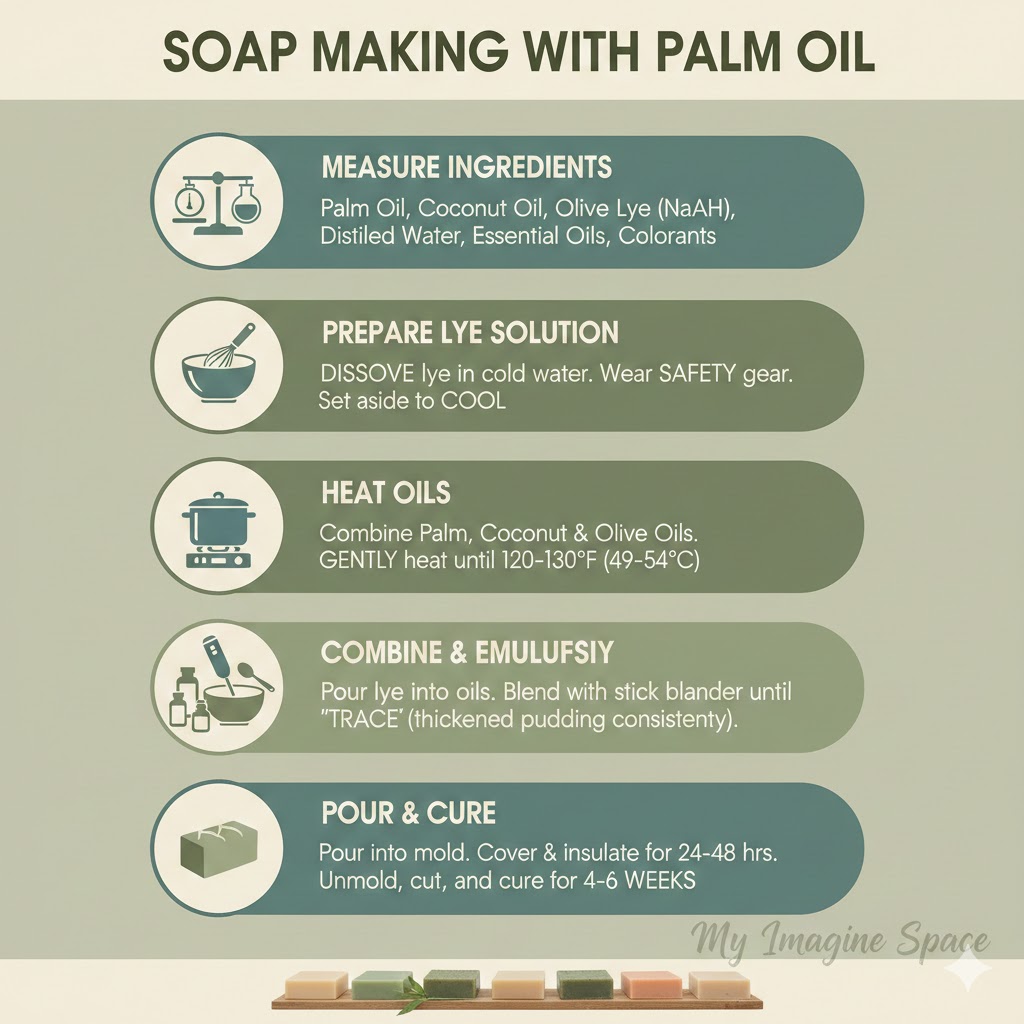
Soap making with palm oil generally refers to the Cold Process Soap method, a technique where oils are mixed with a sodium hydroxide solution to induce saponification. Palm oil specifically serves as a structural fat, providing palmitic and stearic acids that harden the bar.
Historically, tallow (rendered animal fat) served this purpose, but palm oil emerged as the premier vegetable-based alternative for vegans and plant-based artisans. It is the backbone of many recipes because it mimics the fatty acid profile of animal fats without using animal products. Have you ever wondered why commercial “vegetable” soaps feel so similar to traditional tallow soaps?
Sustainable palm oil is often identified by the RSPO (Roundtable on Sustainable Palm Oil) certification, ensuring the production does not contribute to deforestation or habitat loss.
This craft requires a blend of precise chemistry and artistic flair. You are not just melting and pouring; you are calculating molecular weights and managing exothermic reactions. It is best suited for intermediate crafters who have already dabbled in basic melt-and-pour or single-oil batches.
Compared to liquid soap making or hot process methods, working with palm oil in cold process allows for intricate designs. Because palm oil is slow to move to “trace” (the thickening point), it gives the artisan time to swirl colors and create layers before the soap hardens.

Essential Materials and Tools
To create these bars, you need specific equipment dedicated solely to soap making. Safety is paramount when handling lye, so never skip the protective gear.
| Item Category | Specifications |
|---|---|
| Structural Oil | RSPO Certified Sustainable Palm Oil (refined) |
| Base Oils | Coconut oil (for bubbles), Olive oil (for conditioning) |
| Alkali | Sodium Hydroxide (NaOH) crystals or flakes, 99% pure |
| Safety Gear | Rubber gloves, safety goggles, long sleeves |
| Tools | Immersion blender (stick blender), digital scale, stainless steel pot |
| Mold | Silicone loaf mold or wooden box with silicone liner |
Key Techniques and Skills
Mastering palm oil requires specific techniques that differ from working with liquid oils like almond or olive oil. Here are the core skills I rely on for every batch.
- Homogenizing the Container: Melting the entire bucket of palm oil before measuring to redistribute settled stearic acid.
- Temperature Balancing: Bringing both the lye water and oil mixture to within 10 degrees of each other (usually around 100°F).
- Stick Blending: Using short bursts to emulsify without creating excessive air bubbles.
- Recognizing Trace: Identifying when the batter reaches the consistency of thin pudding.
- Insulating: Wrapping the mold in towels to encourage the gel phase, which intensifies colors.
- Beveling: Trimming the sharp edges of cut bars for a professional look and feel.
- Curing: Storing bars in a ventilated area to allow excess water to evaporate.
- Calculating Superfat: Adjusting the lye amount to leave unsaponified oils for skin conditioning.
Skill Level and Time Investment
Soap making is not a weekend hobby you can rush; it requires patience and planning. The active work is intense, but the waiting period is where the magic happens.
| Skill Level | Time Investment | Key Milestones |
|---|---|---|
| Beginner | 2-3 hours active | Understanding safety and basic mixing |
| Intermediate | 3-4 hours active | Formulating recipes and managing trace |
| Advanced | 5+ hours active | Complex swirls and temperature manipulation |
| Curing Phase | 4-6 weeks passive | Hardening and pH neutralization |
Advantages and Challenges
After years of tweaking recipes, I have found that palm oil offers unique benefits, though it comes with its own set of difficulties that every crafter must weigh.
Palm oil creates a uniquely creamy, stable lather that feels luxurious on the skin and persists throughout the entire shower, unlike the fleeting bubbles of coconut oil alone.
- Creates a very hard, durable bar that lasts a long time.
- Provides a creamy, stable lather rather than large, fluffy bubbles.
- Economical compared to exotic butters like shea or cocoa.
- Slow moving batter allows for complex artistic designs.
- Vegetable-based alternative to lard or tallow.
- White color base allows for vivid colorants and micas.
- Requires strict ethical sourcing due to environmental impact.
- Must be fully melted before use to avoid inconsistent batches.
- Solid at room temperature, requiring more prep time than liquid oils.
- Can cause false trace if the temperature drops too quickly.
Real Project Applications
One of my favorite applications for a high-palm formula is the “swirl technique” soap. Because palm oil behaves so well and thickens gradually, I can separate my batter into four different cups, color them with clays or micas, and pour them back into the mold in intricate patterns. A standard batch usually fits a 10-inch loaf mold, producing about 8 to 10 one-inch bars.
Another excellent project is a mechanic’s scrub bar. I combine palm oil for hardness with ground walnut shells or pumice. The structural integrity of the palm oil holds the heavy exfoliants in suspension perfectly, preventing them from sinking to the bottom of the mold. Isn’t it frustrating when all your scrubbing bits end up on one side of the soap?
For a perfect facial bar, try a recipe with 30% palm oil, 40% olive oil, and 20% coconut oil to balance cleansing power with gentleness.
I also use palm-heavy recipes for wedding favors. The resulting bars are stark white (if using refined oil) and hold sharp corners, making them look incredibly elegant when wrapped in simple parchment and twine. These batches are reliable, which is crucial when you are making 200 bars for a client’s big day.
The Learning Experience
Learning to use palm oil came with a specific hurdle: the “stearic spots.” I once ruined a batch because I scooped solid palm oil from the top of my 5-gallon bucket without melting the whole thing first. The resulting soap had white, waxy spots throughout because the hard fatty acids had settled at the bottom of the bucket, and I had used the softer oil from the top.
You must always melt and stir your entire master container of palm oil before weighing it out to ensure the fatty acids are evenly distributed.
Beginners often struggle with temperature control. If your palm oil is too hot and your lye water is too cold, the palm oil can re-solidify instantly upon contact, creating a “false trace” that looks like soap but is actually just clumped oil. It feels like a disaster, but it is a rite of passage for us all.
There are wonderful communities online, particularly soap-making forums and social media groups, where you can troubleshoot these issues. I found that watching videos of “trace” was more helpful than reading about it, as seeing the texture change is intuitive.
Comparison with Similar Crafts
It helps to understand where palm oil soap sits in the spectrum of fiber and fat arts. It is distinct from other soap types.
| Aspect | Palm Oil Soap | Castile (100% Olive) | Melt and Pour |
|---|---|---|---|
| Hardness | Very High | Very Hard (after months) | Medium |
| Cure Time | 4-6 Weeks | 6-12 Months | None (immediate use) |
| Design Control | High | Low (too runny) | Medium (sets fast) |
| Lather | Creamy/Stable | Slimy/Low | Variable |
Common Questions from Fellow Crafters
Q: Can I just leave palm oil out of a recipe if I don’t have it?
A: No, you cannot simply remove it. You must recalculate the lye amount using a soap calculator, or the soap will be dangerous. You would also need to replace it with another hard butter to maintain the bar’s texture.
Q: Why does my palm oil soap have a layer of white ash on top?
A: That is soda ash, a harmless reaction between unsaponified lye and air. You can prevent it by spraying the top with rubbing alcohol immediately after pouring.
Q: Is palm oil bad for the environment?
A: Conventional palm oil production is destructive, but certified sustainable palm oil (CSPO) is grown differently. As artisans, we have the power to support the good supply chain.
Never handle raw soap batter without gloves; the high pH of the active lye will cause chemical burns on your skin instantly.
Q: How much palm oil should I use in my recipe?
A: A standard usage rate is between 25% and 50% of your total oils. Going higher can make the soap too brittle and drying for some skin types.
Q: Can I use the red palm oil instead of the white refined kind?
A: Yes, but be aware that unrefined red palm oil will turn your soap a vibrant orange or yellow color, which is beautiful but limits your design options.
Q: What happens if I cut the soap too late?
A: Palm oil soaps harden relatively quickly. If you wait more than 24-48 hours to cut, the loaf might crumble or require excessive force to slice.

My Personal Results and Insights
Tracking my batches over the years has revealed interesting data points regarding cost and quality. The switch to palm oil stabilized my production.
| Project Type | Outcome |
|---|---|
| Pure Olive Oil Batch | 6 month cure, slime factor high, low material cost |
| Palm/Coconut/Olive Blend | 4 week cure, hard bar, excellent lather, moderate cost |
| Shea Butter Substitute | 5 week cure, luxury feel, very high material cost |
| Design Intricacy | Palm blends allow for 10-15 minutes of working time |
If we can create a product that rivals luxury store brands for a fraction of the cost, why wouldn’t we invest the time to learn the skill?
Final Thoughts and My Recommendation
After years of stirring pots and slicing loaves, I can confidently say that mastering palm oil is essential for anyone serious about cold process soap making. It provides the structural “skeleton” that makes a bar of soap practical, durable, and enjoyable to use. While the learning curve regarding temperature and trace takes practice, the results are undeniably professional.

I highly recommend this craft to patient individuals who enjoy the intersection of science and cooking. If you are looking for instant gratification, melt-and-pour is a better starting point. However, if you want full control over what touches your skin and enjoy the slow, meditative process of creation, this is for you.
Be prepared for the addiction; once you use your own handcrafted bar, store-bought soap will never feel the same again.
Please, if you choose to pursue this, commit to sourcing RSPO-certified oils. It is a small step that allows us to enjoy this versatile ingredient while respecting the planet. The satisfaction of holding a hard, smooth bar of soap that you created from raw ingredients is a feeling unlike any other in the crafting world.