The alchemy of turning simple fats and caustic salts into a luxurious, skin-nourishing bar has captivated me for over a decade. It started as a curiosity about natural living, but quickly turned into a passionate pursuit of the perfect lather and scent profile.
- My Journey with Cold Process Soap Making
- What This Craft Really Entails
- Essential Materials and Tools
- Key Techniques and Skills
- Skill Level and Time Investment
- Advantages and Challenges
- Real Project Applications
- The Learning Experience
- Comparison with Similar Crafts
- Common Questions from Fellow Crafters
- My Personal Results and Insights
- Final Thoughts and My Recommendation
My Journey with Cold Process Soap Making
I still remember the first time I suited up in my kitchen, looking more like a scientist than a crafter with my goggles and rubber gloves. I was terrified of the lye, treating the jar like it was radioactive material, my heart pounding as I measured the crystals.
The transformation from oil and water to solid soap is one of the most satisfying chemical reactions you can witness in a home kitchen.
That first batch was a simple olive oil castile soap, and honestly, I was impatient and cut it too soon, leaving fingerprints permanently indented in the soft bars. But the moment I washed my hands with something I had created from scratch, feeling the rich glycerin that commercial bars strip away, I was hooked.
Over the years, I’ve learned that soap making is a dance between precision and creativity. I once ruined an expensive batch of shea butter soap by adding a spicy clove essential oil that accelerated the mixture so fast it hardened in the pot before I could pour it.

What This Craft Really Entails
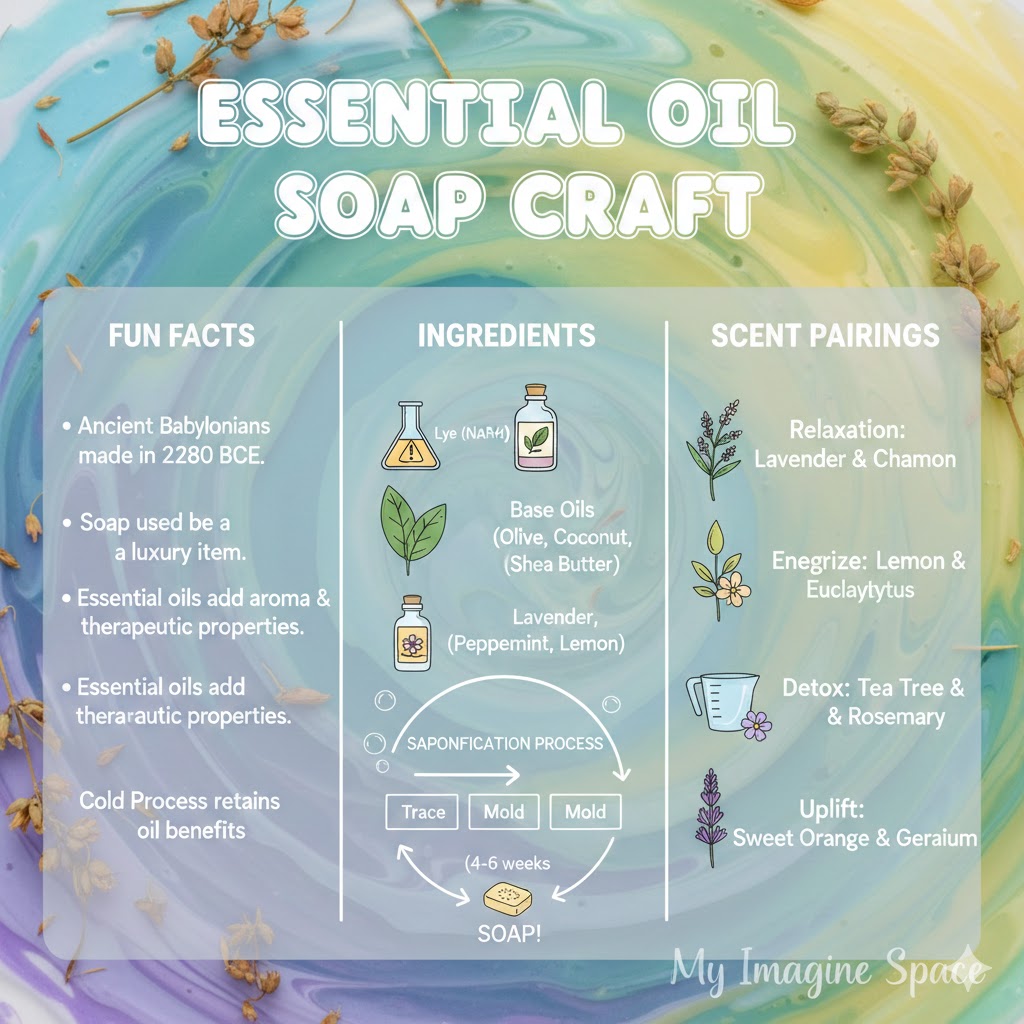
At its core, soap making is the process of saponification, a chemical reaction where fatty acids (oils and butters) react with a strong alkali (sodium hydroxide, also known as lye).

It is less about “crafting” in the decorative sense and more akin to baking or chemistry; precision is non-negotiable. If you mismeasure your flour in a cake, it tastes flat; if you mismeasure lye in soap, it can be unsafe to use.
Saponification is an exothermic reaction, meaning it generates its own heat as the molecules rearrange themselves into soap.
This craft is best suited for individuals who are detail-oriented and patient, as the best soaps require weeks of curing time to reach their full potential. Have you ever wondered why handmade soap doesn’t leave your skin feeling tight and dry like generic supermarket bars?
The answer lies in the natural glycerin produced during saponification, which commercial manufacturers often remove to sell separately in lotions. In our craft, we leave that moisturizing goodness right where it belongs.
Essential Materials and Tools
To start, you don’t need a dedicated studio, but you do need tools that are exclusively for soap making. You should never use your soap pots for cooking food afterward due to the risk of lye residue.
| Item Category | Specifications |
|---|---|
| Safety Gear | Heavy-duty rubber gloves, wrap-around safety goggles, long sleeves |
| Measurement | Digital kitchen scale (must measure to the gram/ounce) |
| Mixing Vessels | Stainless steel pots or heavy-duty #5 plastic containers (no aluminum) |
| Blending | Stick blender (immersion blender) – essential for reaching trace |
| Molds | Silicone loaf molds or wooden boxes lined with freezer paper |
| Ingredients | Sodium Hydroxide (Lye), Distilled Water, Olive Oil, Coconut Oil, Essential Oils |
Never use aluminum pots or utensils, as the lye will react with the metal, creating hydrogen gas and ruining your soap.
Key Techniques and Skills
Mastering soap making requires understanding how different oils behave and how to manage the batter’s consistency.
- Lye Safety: Properly handling and storing sodium hydroxide beads or flakes.
- Oil Balancing: Calculating the ratio of hard oils (palm, coconut) to soft oils (olive, almond) for bar hardness.
- Temperature Control: Bringing lye water and oils to similar temperatures (usually 100-120°F) before combining.
- Identifying Trace: Recognizing the critical moment when the emulsion is stable and looks like thin pudding.
- Scent Anchoring: Mixing essential oils with clays or starches to prevent the scent from fading during the cure.
- Swirling: Pouring different colored batters to create decorative patterns inside the bar.
- Insulation: Wrapping the mold in towels to force the soap through “gel phase” for brighter colors.
- Curing: Rotating bars in a well-ventilated area to allow excess water to evaporate.
Skill Level and Time Investment
Soap making has a moderate learning curve; the chemistry scares some off, but the process is logical.
| Skill Level | Time Investment | Key Milestones |
|---|---|---|
| Beginner | 2-3 hours active + 4 weeks cure | Learning safety, mixing a single-color batch, cutting bars evenly. |
| Intermediate | 3-4 hours active + 4-6 weeks cure | Formulating own recipes, using natural colorants, double pours. |
| Advanced | 5+ hours active + 6+ months cure | Intricate swirls, milk soaps, luxury ingredients, transparent soap. |
Always run your recipe through a reliable online soap calculator to ensure your lye amount is safe, even if you found the recipe in a book.
Advantages and Challenges
There is a distinct difference between the romantic idea of making soap and the practical reality of having buckets of oil in your kitchen.
The Joys of the Process:
- Complete control over ingredients, allowing you to eliminate synthetic detergents and preservatives.
- Endless creativity with natural colorants like spinach powder, turmeric, and clays.
- The sensory experience of blending essential oils is deeply therapeutic.
- It is significantly cheaper in the long run if you buy oils in bulk.
- Handmade soap makes for a genuinely impressive and useful gift.
- The chemistry aspect is intellectually stimulating and rewarding to master.
The Real Struggles:
- The curing time tests your patience; you cannot use what you make immediately.
- Initial equipment costs can be high if you don’t have spare stainless steel pots.
- Cleaning up greasy, raw soap batter is messy and requires care.
- Essential oils are expensive and can fade or morph during the chemical reaction.
Real Project Applications
One of my favorite projects to teach beginners is a “Kitchen Gardener” bar. This project uses a high percentage of coconut oil for cleansing power, blended with poppy seeds for exfoliation.
I scent this bar with a blend of lemongrass and rosemary essential oils. These oils are robust enough to survive the high pH of raw soap and provide a fresh, deodorizing scent that cuts through garlic and onion smells on your hands.
Another beautiful application is the facial bar. For this, I swap out the coconut oil for gentler babassu oil and add activated charcoal. The charcoal gives the soap a striking jet-black appearance and helps draw impurities from the skin.
I recently made a batch of “Sleepy Time” bars using purple Brazilian clay and lavender essential oil that became the most requested item among my friends.
I usually make these in a standard 10-inch loaf mold, which yields about 10 one-inch bars. It’s the perfect size for a weekend project that stocks your bathroom for months.
The Learning Experience
When you first start, you will likely encounter the dreaded “false trace.” This happens when you think the oils and lye are mixed because the mixture thickens, but they haven’t actually emulsified.
I learned this the hard way when I poured a batch into the mold, came back the next day, and found a layer of caustic oil floating on top of the solid soap. It was heartbreaking to throw it away, but it taught me to use my stick blender more effectively.
Have you ever tried to rush a process only to have it backfire completely? In soap making, patience is a physical ingredient.
You will also learn that essential oils behave differently than fragrance oils. Citrus oils, for instance, are notorious for fading. I discovered that folding the essential oil into a bit of kaolin clay before adding it to the batter acts as a fixative, helping the scent last longer.
Community support is vital. I spent hours on soap making forums where veterans shared their “soap fails,” which made me feel much better about my own uneven batches.
Comparison with Similar Crafts
It helps to understand where Cold Process (CP) soap making sits in the fiber and chemical arts spectrum.
| Aspect | Cold Process (My Craft) | Melt and Pour | Hot Process |
|---|---|---|---|
| Creative Control | Total control of ingredients | Limited to base choice | High control, rustic look |
| Texture | Smooth, creamy, hard | Often sweating, softer | Rougher, “mashed potato” look |
| Wait Time | 4-6 weeks cure | Hours to harden | Ready immediately (technically) |
| Safety Risk | High (handling active lye) | Low (base is already reacted) | High (active lye + heat) |
Common Questions from Fellow Crafters
Q: Can I use food coloring to dye my soap?
A: No, food coloring will not work. The high pH of the lye will morph the colors (red often turns brown) or cause them to fade instantly. Stick to micas or natural clays.
Q: Is the lye dangerous to keep in the house?
A: Like bleach or drain cleaner, it is safe if stored correctly. Keep it in a sealed container, high up, labeled clearly, and away from moisture and children.
Q: Why did my soap develop a white dusty layer on top?
A: That is called “soda ash.” It’s harmless! It happens when the unsaponified lye reacts with air. You can steam it off or just wash it away with the first use.
Q: Can I use fresh fruit or juices in my soap?
A: You can, but it’s tricky. The sugars in fruit juice can overheat the soap, causing it to volcano out of the mold. You must freeze the juice first and add the lye slowly.
Q: How much essential oil should I add?
A: This is critical for safety. Usage rates vary by oil, but generally, do not exceed 3% of the total oil weight to prevent skin irritation.
Q: Does handmade soap expire?
A: Yes. Because we use fresh oils and no synthetic preservatives, soap can develop “DOS” (Dreaded Orange Spots) or go rancid after a year or two, smelling like old crayons.
My Personal Results and Insights
Tracking my batches has been essential for consistency. I keep a logbook of every single pour.
| Project Type | Outcome |
|---|---|
| Bastille Soap (High Olive Oil) | Took 6 months to cure but resulted in the mildest, hardest bar I’ve ever used. |
| Salt Bars | Hard as a rock within 2 hours. Learned to cut these almost immediately or they shatter. |
| Milk Soaps | Turned brown due to scorching initially; learned to freeze the milk before adding lye. |
Never, ever pour water into the lye crystals; this can cause an explosive volcanic reaction that sprays caustic liquid.
Always pour the lye crystals slowly into the water while stirring to dissipate the heat safely. This simple rule is the most important safety habit you will form.

Final Thoughts and My Recommendation
Cold process soap making is one of the most rewarding skills I have ever learned. There is a profound sense of self-reliance that comes from creating a daily necessity from scratch. It connects you to a historical tradition of artisans and chemists.
I highly recommend this craft to anyone who loves science, cooking, or precise formulation. If you are someone who prefers instant gratification, you might find the 4-week curing phase frustrating, and perhaps Melt and Pour would be a better starting point.
However, if you are willing to respect the safety protocols and invest the time, the result is a product far superior to anything you can buy in a store. Just be warned: once you start using your own custom-blended, essential oil-rich soaps, you will never want to go back to commercial bars again.
The secret to great soap is not the most expensive oil, but the patience to let the bar cure long enough to become mild and long-lasting. Gather your safety gear, clear off your kitchen counter, and give it a try—just remember to keep the vinegar nearby, just in case!