
There is something deeply satisfying about watching a simple mixture of oils and lye transform into a solid, functional piece of art that you can hold in your hand. I first started making soap because I wanted to control exactly what touched my skin, but I stayed for the endless creative possibilities of molding and sculpting.
- My Journey with Soap Making
- What This Craft Really Entails
- Essential Materials and Tools
- Key Techniques and Skills
- Skill Level and Time Investment
- Advantages and Challenges
- Real Project Applications
- The Learning Experience
- Comparison with Similar Crafts
- Common Questions from Fellow Crafters
- My Personal Results and Insights
- Final Thoughts and My Recommendation
My Journey with Soap Making
My first attempt at using a detailed silicone mold was, quite honestly, a disaster. I was so eager to see the finished product that I poured my soap base while it was still scalding hot, convinced it would flow better into the crevices.

That messy afternoon taught me that soap making is less about force and more about timing and temperature. Once I learned to respect the cooling process, my results transformed from amateur experiments to professional-quality bars.
“Soap making is the perfect marriage of chemistry and art; if you respect the science, the art will follow.”
Over the years, I’ve moved from simple rectangular loaf molds to intricate 3D shapes and custom-made silicone inlays. There is still a thrill every time I unmold a batch—a “reveal” moment that never gets old.
What This Craft Really Entails
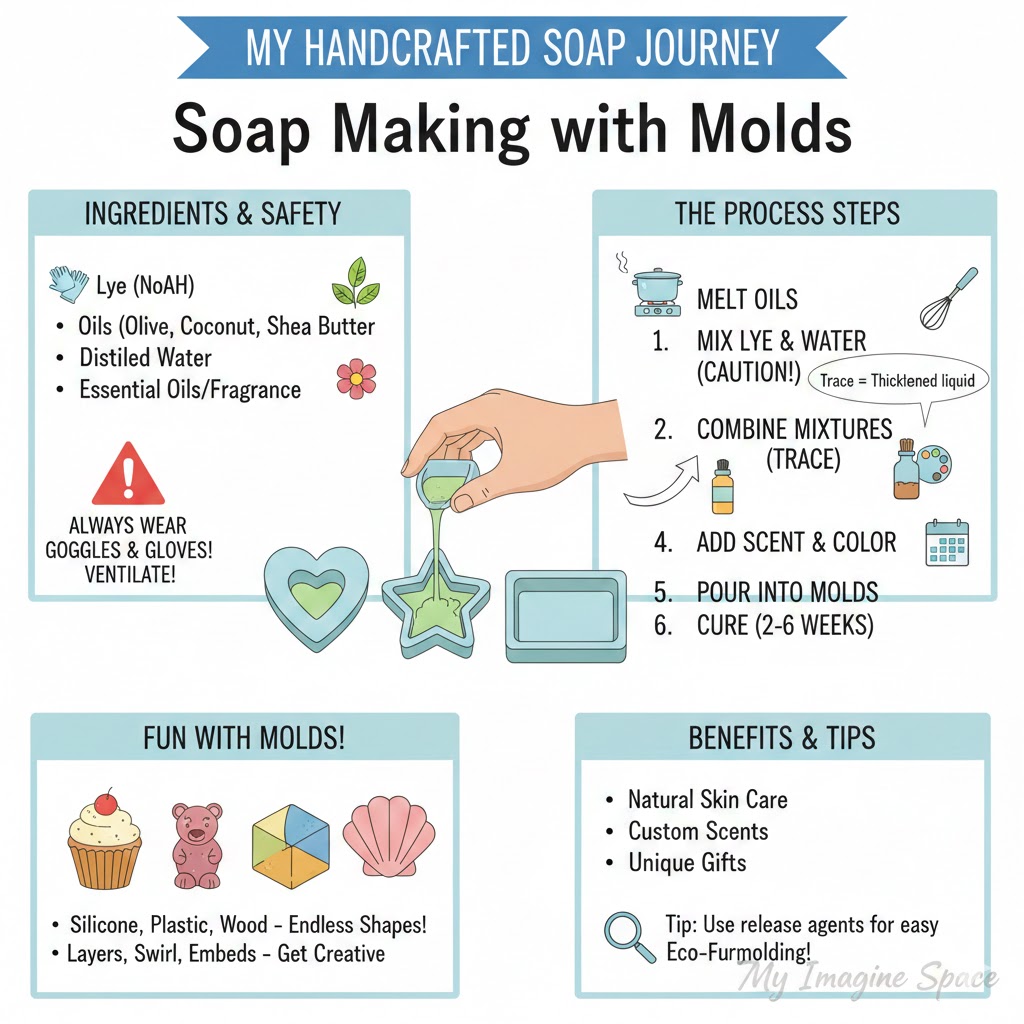
Molded soap making generally falls into two categories: **Melt and Pour** (MP) and **Cold Process** (CP). Melt and Pour uses a pre-made base that you melt, scent, color, and cast, making it accessible and immediate.
Cold Process is the traditional method involving the chemical reaction of **saponification** between oils and lye. It requires more safety precautions and patience, as the soap must cure for weeks.
Regardless of the method, the mold is your canvas. Historically, soap was cast in large wooden blocks purely for utility, but modern crafters use everything from silicone baking sheets to PVC pipes.
Modern silicone molds have revolutionized the industry, allowing for “undercuts” and complex 3D details that rigid plastic or wooden molds could never achieve.
This craft is perfect for those who enjoy precise measurements and color theory. It compares closely to candle making or chocolate casting, as temperature control is the variable that determines success or failure.
Have you ever wondered why some handmade soaps feel slimy while others feel luxurious? It often comes down to the balance of hard and soft oils and the precision of the mold size versus the cure time.

Essential Materials and Tools
| Item Category | Specifications |
|---|---|
| Base Material | High-quality Glycerin Base (MP) or Oils like Olive/Coconut (CP) |
| Molds | Food-grade silicone (heat resistant), wooden loaf molds, heavy plastic |
| Heating/Mixing | Pyrex glass cups, stainless steel stick blender, double boiler |
| Precision Tools | Digital kitchen scale (grams/oz), infrared thermometer gun |
| Safety Gear | Rubber gloves, safety goggles (crucial for Cold Process) |
| Finishing | Spray bottle with 99% Isopropyl Alcohol |
Key Techniques and Skills
- Temperature Control: Pouring too hot can warp molds; pouring too cool results in clumping and poor detail capture.
- Bubble Elimination: The essential skill of spraying rubbing alcohol immediately after pouring to pop surface tension bubbles.
- Layering: Allowing one color to form a “skin” before pouring a second color to create stripes or landscapes.
- Embedding: Suspending small soap shapes or botanicals inside a clear base without melting them.
- Swirling: Using a hanger or skewer to manipulate colored batter inside the mold for marble effects.
- Beveling: Trimming the sharp edges of a finished bar with a vegetable peeler or planer for a professional feel.
- Trace Management: Recognizing when your batter is thick enough to suspend colors but fluid enough to fill the mold.
To ensure layers stick together without separating later, always score the bottom layer with a fork and spray generously with alcohol before pouring the next layer.
Skill Level and Time Investment
| Skill Level | Time Investment | Key Milestones |
|---|---|---|
| Beginner (Melt & Pour) | 1–2 hours active | Mastering smooth tops, no bubbles, proper scent ratio. |
| Intermediate (Design) | 3–4 hours active | Creating sharp layers, embedding objects, basic swirls. |
| Advanced (Cold Process) | 4 hours + 4-6 weeks cure | Formulating recipes, advanced swirling, milk/beer soaps. |
Advantages and Challenges
The Benefits:
- Total control over ingredients allows you to avoid allergens and harsh detergents found in commercial bars.
- It is incredibly scalable; you can make one bar or one hundred bars in a single afternoon.
- The aesthetic options are limitless, from soaps that look like gemstones to realistic food replicas.
- Silicone molds are durable and reusable, making the long-term equipment cost relatively low.
- Soap is a consumable art, meaning your creations don’t clutter up the house—they get used and enjoyed.
- The community is vibrant and sharing, with endless recipes available for free.
The Challenges:
- Initial setup costs for fragrances, molds, and oils can be higher than expected.
- Cold Process soap requires a dedicated curing space with good airflow for 4 to 6 weeks.
- Cleaning up waxy, oily residue from tools is time-consuming and requires very hot water.
- “Sweating” or glycerin dew can ruin the look of soap in humid climates if not wrapped immediately.
Lye (Sodium Hydroxide) is a caustic chemical used in Cold Process soap that causes severe burns; never skip safety goggles or work around children and pets.
Real Project Applications
One of my favorite projects involved creating “gemstone” soaps for a wedding favor order. I chopped up leftover colored soap scraps into irregular chunks and placed them into a loaf mold.
I then poured a clear, scented glycerin base over the chunks. Once solidified and sliced, each bar looked like a slice of terrazzo or stained glass. It was a perfect way to reduce waste and create something stunning.
For the holidays, I often use individual cavity molds shaped like snowflakes. By dusting the mold with white mica powder before pouring a blue base, the intricate snowflake pattern pops with a metallic shimmer.
Using individual cavity molds eliminates the need for cutting, which guarantees that every single bar is identical in size and weight—perfect for gifts.
Another practical application is “mechanic’s soap.” I use a simple rectangular mold and add ground walnut shells or pumice to the batter. The mold shape fits perfectly in the hand for scrubbing.
Have you ever thought about how much money you spend on body wash? Making a batch of twelve bars costs a fraction of the price and lasts for months.
The Learning Experience
The learning curve for molding soap is often about learning to wait. Beginners frequently try to unmold their soap too early, resulting in dented corners or soap that sticks to the silicone.
I also struggled initially with fragrance fading. I didn’t realize that adding scent to base that was too hot would cause the fragrance to evaporate before the soap even cooled.
My breakthrough moment came when I started using an infrared thermometer. Never guess the temperature of your soap; a difference of ten degrees can ruin a design.
Books like “The Soapmaker’s Companion” were vital to my growth, as were YouTube tutorials by seasoned crafters who showed their failures as well as their successes.
There is a distinct community of “soapers” online who are incredibly supportive. We share tips on everything from where to buy bulk oils to how to fix a batch that has “seized” (hardened instantly).
Comparison with Similar Crafts
| Aspect | Soap Making | Candle Making | Resin Art |
|---|---|---|---|
| Utility | High (Daily Use) | High (Ambiance) | Decorative |
| Cleanup | Water Soluble (Easy) | Wax (Difficult) | Chemicals (Hard) |
| Toxicity | Low to Moderate (Lye) | Low | High (Fumes) |
| Cure Time | Hours to Weeks | Days | 24-72 Hours |
Common Questions from Fellow Crafters
Q: Why is my soap sweating little droplets?
A: This is glycerin dew, common in humid environments. The glycerin in the soap draws moisture from the air. Wrap your bars tightly in plastic wrap immediately after unmolding.
Q: Can I use food coloring to dye my soap?
A: No. Food coloring is water-based and will “bleed” or migrate, turning your crisp layers into a muddy blur. Use soap-safe micas or oxides instead.
Q: How do I get the soap out of the mold if it’s stuck?
A: Pop the mold in the freezer for 15-20 minutes. The cold shrinks the soap slightly, allowing it to pop out easily. Don’t leave it too long or it may crack.
Q: What causes that white dusty layer on my Cold Process soap?
A: That is called soda ash. It happens when lye reacts with air. You can steam it off with a garment steamer or wash it off quickly; it’s purely cosmetic.
Q: Can I put fresh rose petals in my soap?
A: Generally, no. Fresh botanicals will rot inside the soap and turn brown/black. You must use completely dried herbs and flowers.
Q: Why did my fragrance disappear?
A: You likely added it when the soap was too hot, or you used a fragrance not rated for soap making (like some candle oils). Always check the supplier’s notes.
My Personal Results and Insights
Is there anything quite as thoughtful as a gift that was literally hand-sculpted and chemistry-balanced specifically for the recipient?
| Project Type | Outcome |
|---|---|
| Basic Loaf Batch | Yields 10 bars; Cost approx. $3.00/bar; Success rate 98% |
| Intricate Silicone Mold | Yields vary; High visual impact; Requires patience; Success rate 85% |
| Swirl Technique | Unique patterns; High difficulty; Best for selling; Success rate 75% |

Final Thoughts and My Recommendation
Soap making is a journey that rewards patience and precision. It has taught me to slow down and pay attention to the details, from the temperature of my oils to the humidity in the air.
If you are just starting, I highly recommend beginning with Melt and Pour. It allows you to focus on the fun parts—scent, color, and molding—without the stress of handling dangerous chemicals. It builds your confidence and helps you understand how liquids behave in molds.
Never use your soap-making pots, spoons, or stick blenders for food preparation again; keep your craft tools strictly separate for safety.
The secret to a perfect surface is simply waiting until the mold is completely cool to the touch before attempting to open it. Rushing is the enemy of quality in this craft.
For those willing to invest the time, the ability to create custom, skin-loving bars is an incredible skill. Start simple, master your temperatures, and have fun with the process. Your skin (and your friends) will thank you.




Thinking of selling soap at craft fairs. What prices work best? $5-10 per bar?
Pricing can vary depending on the size, ingredients, and complexity of the soap. Generally, $5-10 per bar is a good range, but you may be able to charge more for unique or specialty soaps. Consider researching what similar vendors are charging at your target craft fairs to ensure you’re competitive.
I’ve got arthritis and limited mobility, making it hard to handle hot soap bases. Are there any adaptive tools or techniques for pouring into molds without straining my hands?
Regarding adaptive tools for soap making, there are several options available. You can look into using a soap pouring pitcher with a handle, which can make it easier to manage the hot soap base. Additionally, consider using a thermometer with a long probe to monitor the temperature without having to hold the thermometer. There are also ergonomic mold handles and soap cutting tools designed to reduce strain on your hands.