The alchemy of turning simple oils and lye into luxurious bars of art has always fascinated me, transforming a mundane daily necessity into a sensory experience. There is a profound satisfaction in creating something that not only looks beautiful but also nurtures the skin, and turning that passion into a business was one of the most rewarding decisions of my life.
- My Journey with Artisan Soap Making
- What This Craft Really Entails
- Essential Materials and Tools
- Key Techniques and Skills
- Skill Level and Time Investment
- Advantages and Challenges
- Real Project Applications
- The Learning Experience
- Comparison with Similar Crafts
- Common Questions from Fellow Crafters
- My Personal Results and Insights
- Final Thoughts and My Recommendation
My Journey with Artisan Soap Making
My adventure began not in a studio, but in a cramped kitchen with a stick blender and a terrifying obsession with chemistry. I remember my hands shaking the first time I donned my safety goggles to mix sodium hydroxide, feeling like a mad scientist about to discover a new element. That first batch was a simple, unscented olive oil soap, and while it looked plain, the feeling of washing with something I created from scratch was indescribable.

Transitioning to selling was a steep learning curve that taught me that a beautiful swirl doesn’t matter if the scent fades in a week. I once ruined an entire holiday batch by using a fragrance oil that accelerated the batter so fast it turned into “soap on a stick” before I could even pour it. Those early disasters were humble teachers, showing me that consistency and patience are just as important as creativity in this trade.
There is no such thing as a failed batch of soap, only a lesson in chemistry and an opportunity to make laundry detergent.
What This Craft Really Entails
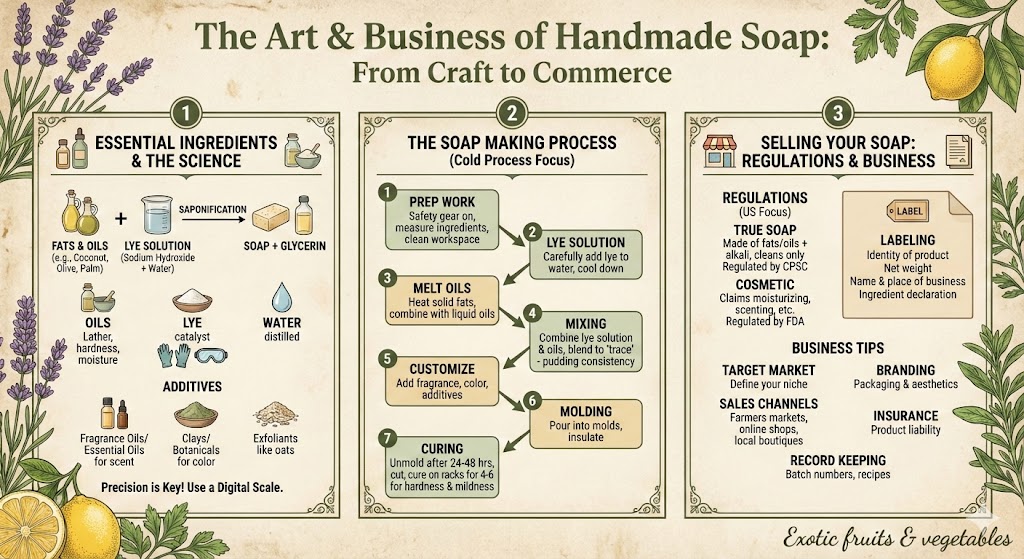
At its core, soap making is a chemical reaction called **saponification**. While we often think of it as a domestic art, it is actually a precise science where specific ratios of fatty acids interact with a strong alkali to create a completely new substance. In the artisan market, we primarily focus on the cold process method, which allows for the most artistic control and skin-loving benefits.
This craft traces its lineage back to ancient Babylon, yet the modern artisan movement has elevated it from a survival skill to a high-end luxury trade. It requires a dual mindset: you must be exact like a chemist when formulating recipes, but expressive like a painter when designing the aesthetic of the bar. Have you ever wondered why handmade soap feels so creamy compared to store-bought bars?

Unlike knitting or painting, soap making is a delayed gratification art. You cannot see or use your final product immediately. It requires a waiting period that tests your patience but rewards you with a harder, milder, and longer-lasting bar. It compares closely to baking, where precision in measurement dictates the success of the rise and texture.
Essential Materials and Tools
| Item Category | Specifications |
|---|---|
| Base Oils & Fats | Olive oil, coconut oil, palm oil (sustainable) or shea butter |
| Alkali | 100% Sodium Hydroxide (Lye) flakes or beads |
| Safety Gear | Heavy-duty rubber gloves, wrap-around safety goggles, long sleeves |
| Mixing Tools | Stainless steel stick blender (immersion blender), heat-safe plastic pitchers |
| Measurement | Digital kitchen scale (must measure to the gram) |
| Molds | Silicone loaf molds or wooden molds with silicone liners |
Always use a digital scale for your measurements; volume measurements like cups or tablespoons are inaccurate for soap making and can lead to lye-heavy, dangerous soap.
Key Techniques and Skills
- Lye Solution Preparation: Mastering the safe mixing of water and sodium hydroxide without splashing or inhaling fumes.
- Temperature Control: Learning to combine oils and lye water when they are within 10 degrees of each other for optimal emulsion.
- Recognizing Trace: Identifying the critical moment when the batter thickens to the consistency of thin pudding, signaling emulsification.
- Formulating Recipes: Using “soap calculators” to balance cleansing properties with conditioning properties.
- Swirling Techniques: manipulating colored batter with hangers or skewers to create internal designs like the drop swirl or peacock swirl.
- Superfatting: Calculating a lye discount to ensure there is free-floating oil left in the bar for moisturizing purposes.
- Curing Management: Rotating bars during the drying phase to ensure water evaporation and crystalline structure formation.
- Beveling and Planing: Trimming the edges of the cut soap to give it a professional, finished look suitable for retail.
Skill Level and Time Investment
| Skill Level | Time Investment | Key Milestones |
|---|---|---|
| Beginner | 3-5 hours per batch + 4 weeks cure | Learning safety, basic single-color pours, cutting straight bars |
| Intermediate | 4-6 hours per batch + 4 weeks cure | Layering colors, using fragrance blends, preventing soda ash |
| Advanced | 6-8 hours per batch + 6 weeks cure | Intricate swirls, milk soaps, salt bars, custom formulation |
Be aware that fragrance oils have “flash points” and behavior profiles; some can cause your fluid soap batter to seize into a solid block in seconds.
Advantages and Challenges
The Benefits:
- Consumable Product: Unlike selling paintings, soap washes away, meaning satisfied customers must return to buy more.
- High Margins: If you source materials in bulk, the cost per bar is relatively low compared to the retail price.
- Creative Freedom: The combinations of scent, color, and texture are infinite, allowing for a unique brand identity.
- Skin Benefits: You have total control over ingredients, making it ideal for creating hypoallergenic or vegan options.
- Scalability: You can start in a kitchen and scale up to a workshop without changing the fundamental process.
- Therapeutic Value: The rhythmic process of measuring and mixing can be incredibly meditative and grounding.
The Challenges:
- Curing Space: You need dedicated shelving with good airflow to store hundreds of bars for weeks at a time.
- Heavy Lifting: As you scale, you will be lifting heavy buckets of oil and 50-pound bags of supplies.
- Regulatory Compliance: You must adhere to strict labeling laws (like the FDA or CPSC depending on claims) and insurance requirements.
- Market Saturation: The barrier to entry is low, so standing out requires exceptional branding and product quality.
Real Project Applications
When you are looking to sell, specific projects tend to perform better than others. One of my most successful lines was a “Local Harvest” series where I incorporated honey and beeswax from local apiaries and herbs from community gardens. Customers love a local connection; it transforms a simple bar of soap into a story about their community.
Wedding favors are another massive revenue stream for soap makers. I often create half-sized bars wrapped in custom paper that matches the bridal color scheme. These projects require planning months in advance due to the curing time, but selling 200 bars in a single transaction is fantastic for cash flow. Have you considered how a customized stamp could elevate a plain bar into a premium gift?
Seasonal releases are the heartbeat of the soap business. In autumn, pumpkin and spice soaps sell out immediately, while fresh, aquatic scents dominate the summer markets. I once made a “Coal” soap for Christmas using activated charcoal and anise scent; it started as a joke gift but became one of my best sellers for stocking stuffers.
Building a core collection of 4-6 “always available” scents creates stability, while limited seasonal batches create urgency and excitement for your customers.

The Learning Experience
Beginners often start with “Melt and Pour” bases, which is a great way to learn about fragrance and color without the danger of lye. However, moving to **Cold Process** is where the real artistry lies. The learning curve involves understanding how different oils contribute to the bar’s qualities—coconut oil adds bubbles but can be drying, while olive oil is moisturizing but cures very soft.
A common mistake early on is impatience. I used to poke and prod my fresh soap, trying to cut it too early, which resulted in dented, ugly bars. Another hurdle is “soda ash,” a harmless white powder that forms on top of the soap as it reacts with air. It drove me crazy until I learned to spray the tops with isopropyl alcohol to prevent it.
I found my breakthrough when I stopped relying on other people’s recipes and learned to use a lye calculator to formulate my own. That was the moment I stopped being a recipe follower and became a soap maker. Resources like the Soap Making Forum and tutorials by mentors like Anne-Marie Faiola were instrumental in my growth.
Never add water to lye; always add the lye flakes to the water slowly to prevent a volcanic, caustic eruption.
Comparison with Similar Crafts
| Aspect | Cold Process Soap | Melt and Pour Soap | Candle Making |
|---|---|---|---|
| Difficulty | High (Chemistry involved) | Low (Melting involved) | Medium (Temp control) |
| Danger Level | High (Caustic burns) | Low (Heat burns) | Medium (Fire hazard) |
| Time to Sell | 4-6 Weeks (Cure time) | 2-4 Hours (Cooling time) | 24-48 Hours (Cure time) |
| Customization | Total control of ingredients | Limited by base used | Scent/Color only |
Common Questions from Fellow Crafters
Q: Can I make soap without handling lye?
A: Technically, no. All real soap is made with lye. However, in “Melt and Pour” soap, the lye reaction has already been done by a manufacturer, so you don’t have to handle the raw chemical yourself.
Q: How do I know if my soap is safe to use?
A: You should perform a “zap test” (touching the soap to your tongue—it shouldn’t zap like a battery) after the cure, but the most reliable method is weighing your ingredients precisely and using a lye calculator to ensure there is no excess lye.
Q: Why did my soap turn brown?
A: This is usually due to the vanilla content in your fragrance oil. It oxidizes and turns the soap tan or dark brown. You need a vanilla stabilizer additive or a different scent to prevent this.
Q: How long does handmade soap last on the shelf?
A: If stored in a cool, dry place out of direct sunlight, it can last over a year. However, the scent may fade after 6-9 months depending on the essential oils or fragrances used.
Q: Is it expensive to start a soap business?
A: The initial equipment (stick blender, scale, molds) is affordable, around $100-$200. The recurring costs are oils and fragrances. Buying in bulk is the only way to make a profit.
Q: Do I need insurance to sell at farmers markets?
A: Absolutely. Handcrafted soap and cosmetic guilds offer affordable product liability insurance. One allergic reaction claim could ruin you without it.
My Personal Results and Insights
| Project Type | Outcome |
|---|---|
| First Market Season | Sold 40% of inventory; learned that packaging sells the soap first, scent second. |
| Bulk Oil Purchase | Reduced cost per bar by $1.20, significantly increasing profit margin. |
| Complex Swirl Design | Took 3x longer to make but sold out immediately; proved customers pay for artistry. |
| Failed Batch (Seizing) | Rebatched into “confetti soap” and sold at a discount; recouped material costs. |
The most vital secret to a hard, long-lasting bar of soap is giving it the full 4 to 6 weeks to cure in a dry environment.
Final Thoughts and My Recommendation
Soap making is a discipline that rewards the meticulous and the patient. It is not a craft you can rush, nor is it one where you can “eyeball” your materials. However, if you love the intersection of science and art, and you enjoy the idea of creating a product that people use intimately in their daily lives, it is incredibly fulfilling.
For beginners looking to sell, I highly recommend starting small. Master a simple recipe with three oils (olive, coconut, palm/sustainable) before you buy expensive exotic butters. The market is competitive, but there is always room for high-quality, authentic products. Don’t be discouraged by the chemistry; once you respect the safety rules, the process becomes rhythmic and soothing.
Is it worth the investment? If you are willing to treat it as a business and not just a hobby, the profit margins and customer loyalty make it one of the most viable crafts to monetize. Just remember that you are selling an experience—a moment of self-care in a busy world—not just a bar of soap.