There is a profound satisfaction in crafting items that serve a daily purpose, transforming mundane routines into moments of artistic appreciation. I have always believed that the humblest objects in our homes, like the vessel holding our soap, deserve just as much design attention as the centerpiece on the dining table. My journey into making soap dishes began not as a grand artistic endeavor, but as a practical solution to a messy bathroom sink.
- My Journey with Hand-Crafted Soap Dishes
- What This Craft Really Entails
- Essential Materials and Tools
- Key Techniques and Skills
- Skill Level and Time Investment
- Advantages and Challenges
- Real Project Applications
- The Learning Experience
- Comparison with Similar Crafts
- Common Questions from Fellow Crafters
- My Personal Results and Insights
- Final Thoughts and My Recommendation
My Journey with Hand-Crafted Soap Dishes
I still vividly remember my first attempt at making a soap dish using air-dry clay on my kitchen counter. I was frustrated with store-bought holders that allowed my expensive handmade soaps to turn into sludge, so I decided to sculpt my own solution. That first project was a humbling failure; I didn’t account for proper drainage, and the dish itself dissolved alongside the soap within a week.

What This Craft Really Entails
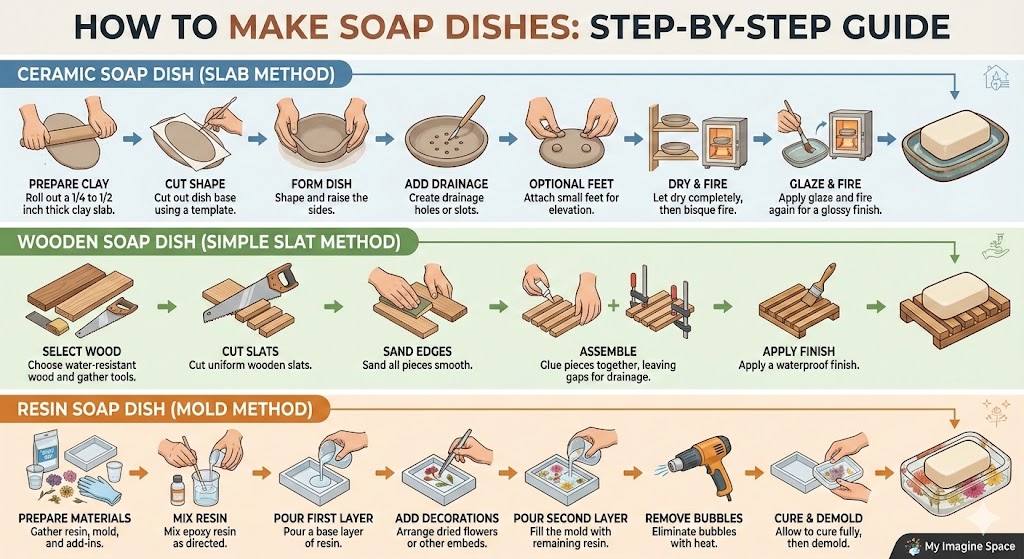
Making soap dishes is primarily a form of slab-building or hand-modeling, usually utilizing polymer clay, epoxy clay, or stoneware. Unlike throwing on a potter’s wheel, this technique is accessible and involves rolling out flat sheets of material to cut, shape, and texturize by hand. It connects the maker to the tactile nature of the material, allowing for organic shapes that rigid molds cannot replicate.
The essence of this craft lies in managing water; you are essentially building a miniature drainage system disguised as home decor. You must understand the physics of how water pools and flows, designing ridges, holes, or spouts that guide moisture away from the soap bar. Have you ever wondered why some dishes stay clean while others accumulate grime immediately?
The beauty of hand-building soap dishes is the freedom from symmetry; unlike factory-made ovals, your creations can mimic leaves, river stones, or abstract geometric forms that fit your specific sink corners.
This craft is ideal for intermediates who have dabbled in basic sculpting but want to create something durable and functional. It requires a step up from decorative figurines because the final piece must withstand constant exposure to water and humidity. It compares closely to ceramic coaster making but adds the complexity of three-dimensional structure and waterproofing.

Essential Materials and Tools
| Item Category | Specifications |
|---|---|
| Primary Material | Polymer Clay (Premo or Fimo) or Stoneware Clay |
| Work Surface | Ceramic tile or glass sheet (for baking and smooth release) |
| Rolling Tools | Acrylic roller and depth guides (playing cards work well) |
| Cutting Tools | Flexible tissue blade and X-Acto knife |
| Texturing Tools | Rubber stamps, lace, or organic materials like leaves |
| Drainage Tools | Straws or small circle cutters for holes |
| Finishing | Wet/dry sandpaper (400 to 1000 grit) |
| Sealing (Optional) | Water-based polyurethane or UV resin |
Key Techniques and Skills
- Slab Rolling: Creating a sheet of clay with perfectly even thickness to prevent cracking during the curing process.
- Template Cutting: Using paper guides to ensure your dish size matches standard soap bars plus wiggle room.
- Edge Softening: smoothing down sharp cut edges with your finger or a little baby oil to ensure the final piece is pleasant to touch.
- Foot Attachment: securely bonding raised feet to the bottom of the dish to lift it off the counter for airflow.
- Beveling: cutting drainage holes at a slight angle to encourage water to drip out rather than getting stuck.
- Slumping: draping the clay sheet over a curved object (like a bowl) to create a gentle concave shape.
- Texturing: impressing patterns deep enough to provide grip for the soap but shallow enough to clean easily.
- Waterproofing: applying multiple thin coats of sealer if using non-vitrified clays to prevent water absorption.
Skill Level and Time Investment
| Skill Level | Time Investment | Key Milestones |
|---|---|---|
| Beginner | 2 Hours + Cure Time | Simple flat slab with drilled drainage holes |
| Intermediate | 4 Hours + Cure Time | Curved dish with attached feet and texture |
| Advanced | 6+ Hours | Complex multi-part designs with spouts or inlays |
Advantages and Challenges
The ability to customize the color palette to match your bathroom tiles exactly is a huge benefit that you simply cannot get with mass-produced items.
- It creates a highly functional item that extends the life of your expensive artisan soaps.
- The project uses a small amount of material, making it cost-effective and great for using up scraps.
- Polymer clay creates a shatter-resistant dish, which is safer for tiled bathroom floors than ceramic or glass.
- You can design specific sizes for non-standard soaps, such as shampoo bars or large body blocks.
- It makes for an incredibly thoughtful and usable gift that doesn’t just sit on a shelf gathering dust.
- The creative possibilities for surface design—from faux marble to terrazzo—are endless.
Be aware that some sealants can turn sticky or yellow over time when exposed to the specific pH levels of certain natural soaps.
- Achieving a perfectly flat base is difficult, and a wobbly soap dish is incredibly annoying to use.
- If drainage holes are too small, they will clog with soap scum and require constant cleaning.
- Waterproofing mistakes can ruin the project; if water gets under your sealant, the finish will peel.
- Clay feet can pop off if they aren’t scored and bonded correctly before baking.
Real Project Applications
One of my favorite projects was a set of “Monstera Leaf” dishes I made for a summer craft exchange. I used a real leaf to impress the veins into green polymer clay, then carefully lifted the edges to create a natural bowl shape. instead of drilling holes, I angled the stem of the leaf downwards to act as a drainage spout, allowing water to run directly into the sink.
Another successful application is the “pebble” drainer. Instead of a solid dish, I created a tray filled with smooth, baked clay stones glued into place. This allows the soap to sit on top of the “stones” while water drips to the bottom tray, evaporating naturally. It was a hit with friends who wanted a spa-like aesthetic in their guest bathrooms.
“Form follows function” is the golden rule here; the most beautiful dish is useless if the soap sits in a puddle of water.
I also frequently make travel soap dishes for family members. These are two-part containers with a textured bottom grid that fits inside a travel tin. It solves the mushy soap problem when traveling and is a project that takes precise measuring but yields incredibly useful results. Why struggle with ziplock bags when you can make a custom travel case?
The Learning Experience
When I started teaching this to others, I noticed that beginners almost always make their clay too thin. They treat it like paper rather than a structural material, leading to dishes that warp or crack in the oven. Learning to trust the strength of a thicker slab (about 6mm or 1/4 inch) is usually the first “aha” moment for new students.
Another common hurdle is patience during the finishing phase. It is tempting to skip sanding, but sanding your edges under water is the difference between a homemade craft and a professional artisan product. I recall ruining a batch because I rushed the cooling process, causing thermal shock cracks—a mistake I never made again.
Community forums for polymer clay artists are invaluable for troubleshooting specific brands of clay. You quickly learn that some brands are too brittle for functional items, while others have the perfect flexibility. Finding a mentor or a good tutorial series on “functional clay items” can save you weeks of trial and error.
Comparison with Similar Crafts
| Aspect | Polymer Clay Modeling | Ceramic Pottery | Resin Casting |
|---|---|---|---|
| Equipment Cost | Low (Home Oven) | High (Kiln/Wheel) | Medium (Molds/PPE) |
| Durability | High (Flexible) | High (Brittle) | Very High |
| Learning Curve | Moderate | Steep | Moderate |
| Toxicity Risk | Low (if not burned) | Low (Silica dust) | High (Fumes) |
Common Questions from Fellow Crafters
Q: Do I really need to seal polymer clay for a soap dish?
A: While polymer clay is plastic and waterproof, the texture can trap grime. A light sanding and buffing is often better than a varnish that might peel, but sealing protects surface treatments like mica powder.
Q: How do I stop the dish from sliding around the sink?
A: I recommend gluing small silicone bumper pads to the bottom of the feet after the dish is fully cured. It provides grip and extra elevation.
Q: Can I use air-dry clay for this?
A: Only if you seal it extremely well with a heavy-duty waterproof resin. Otherwise, the clay will absorb water, soften, and eventually mold.
Q: Why did my feet fall off after baking?
A: You likely didn’t use a bonding agent. For polymer clay, use a little liquid clay or “bake and bond” at the connection point before curing.
Q: What is the best shape for drainage?
A: An oval or rectangle with a slightly convex center (hump in the middle) works best, as it forces water to run off to the sides and out the holes.
Q: How do I clean soap scum off the textured clay?
A: Use an old toothbrush and warm water. Avoid harsh chemical scrubbers that might dull the finish of your clay.
My Personal Results and Insights
| Project Type | Outcome |
|---|---|
| Faux Marble Slab | Most durable, looks expensive, hides soap scum well |
| Intricate Floral Sculpt | Beautiful but nightmare to clean, not practical |
| Self-Draining Spout | Best function, requires precise placement on sink |
| Grid/Grate Style | Excellent drainage, requires strong construction |
For the smoothest finish, wipe your raw clay with a little rubbing alcohol on a lint-free cloth before baking to remove all fingerprints and dust.
Final Thoughts and My Recommendation
Mastering the art of the soap dish has been one of the most practical skills I’ve acquired in my crafting career. It forces you to think about how objects interact with water and daily use, a perspective that improves all your other sculpting projects. The barrier to entry is low, but the ceiling for creativity is incredibly high.
I highly recommend this project for anyone looking to break into functional art without investing in a pottery wheel. It is rewarding to use something you made with your own hands every single morning. While it requires attention to detail—specifically regarding drainage and waterproofing—the result is a sturdy, personalized piece of home decor.
Is it worth the time? Absolutely. The difference between a flimsy plastic holder and a weighted, custom-designed dish is palpable. Start with simple shapes, focus on the drainage mechanics, and don’t be afraid to test your prototypes. You will never look at a bathroom sink the same way again.
Never use standard craft varnishes like Mod Podge for soap dishes; they will re-liquefy when wet and ruin both your hard work and your soap.