There is something profoundly grounding about transforming raw fats and alkali into a luxurious, cleansing bar of soap. I fell in love with this domestic alchemy years ago, seeking a way to control exactly what touched my family’s skin while exploring a medium that blends precise chemistry with artistic expression.
- My Journey with Cold Process Soap Making
- What This Craft Really Entails
- Essential Materials and Tools
- Key Techniques and Skills
- Skill Level and Time Investment
- Advantages and Challenges
- Real Project Applications
- The Learning Experience
- Comparison with Similar Crafts
- Common Questions from Fellow Crafters
- My Personal Results and Insights
- Final Thoughts and My Recommendation
My Journey with Cold Process Soap Making
I still remember the trembling in my hands the first time I donned my safety goggles and measured out sodium hydroxide. I had read every book I could find, yet the idea of working with caustic chemicals in my kitchen felt incredibly daunting. My first batch was a simple, unscented olive oil soap that looked rather plain.
However, the moment I cut into that loaf after twenty-four hours, revealing the creamy, smooth texture inside, I was hooked. It felt like I had rediscovered a lost survival skill, something our ancestors did by necessity that I was doing for joy. The scent of raw soap batter is now one of my favorite smells in the world.
Soap making is the perfect marriage of science and art; you must respect the chemistry to ensure safety, but you need the soul of an artist to create beauty.
One specific memory stands out from my early days involving a floral fragrance oil. I didn’t realize that certain additives could accelerate the chemical reaction, and my fluid batter turned into a solid brick in seconds. I stood there with my stick blender stuck in the pot, laughing at my own “soap on a stick,” learning a valuable lesson about researching ingredients.
What This Craft Really Entails
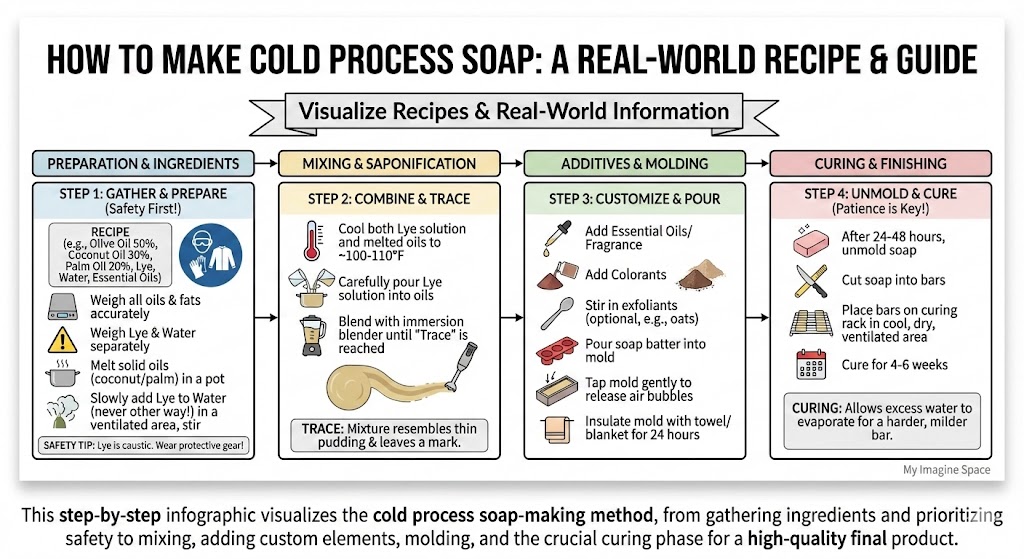
When we talk about making soap from scratch, we are usually referring to **cold process soap making**. This is the traditional method where you mix oils and butters with a lye solution (sodium hydroxide and water) to trigger a chemical reaction called saponification. Unlike “melt and pour” crafting, you are not just reshaping a base; you are creating the compound itself.

Is this craft right for you? It is best suited for those who are patient and detail-oriented. If you love baking but wish you could be more scientific about it, you will thrive here. It requires a dedicated workspace, even if temporary, and a strict adherence to safety protocols that other fiber arts do not demand.
Have you ever looked at the back of a commercial beauty bar and realized you couldn’t pronounce a single ingredient listed there?
The core skill lies in understanding fatty acid profiles. You learn that coconut oil creates big bubbles but can be drying, while olive oil is gentle but cures slowly. Balancing these properties is a lifelong study. It is similar to composing a symphony, where each oil is an instrument playing its part in the final performance.
Comparatively, soap making is more rigid than knitting or embroidery. In needlework, you can usually rip out a mistake and start over. In soap making, once the lye meets the oil, the reaction begins, and there is no turning back. You have to commit to the process and trust your preparation.

Essential Materials and Tools
| Item Category | Specifications |
|---|---|
| Safety Gear | Heavy-duty rubber gloves, wrap-around safety goggles (not just glasses), and long sleeves are non-negotiable. |
| Digital Scale | Must measure in grams and possess a tare function. Kitchen scales are fine, but accuracy to 1g or 0.1g is vital. |
| Stick Blender | An immersion blender (stainless steel shaft preferred) is essential to emulsify the batter before it separates. |
| Mixing Vessels | Stainless steel pots or heat-safe heavy plastic (PP #5) pitchers. Never use aluminum, as lye eats through it. |
| Base Oils | Common staples include Olive oil, Coconut oil, Palm oil (sustainably sourced) or Lard/Tallow, and Castor oil. |
| The Alkali | Sodium Hydroxide (NaOH) crystals or flakes. Must be 100% pure lye, not drain cleaner with additives. |
| Molds | Silicone loaf molds are best for beginners as they make unmolding easy. wood molds with silicone liners are also great. |
Key Techniques and Skills
- Lye Safety: mastering the safe handling, mixing, and storage of caustic soda is the very first skill you must learn.
- Formulating: Using a “lye calculator” to determine the exact amount of lye needed for your specific blend of oils.
- Temperature Control: Learning to mix your lye water and oils when they are within a similar temperature range (usually 100°F–120°F).
- Identifying Trace: Recognizing the point of emulsion where the batter thickens like pudding, indicating it is ready to pour.
- Super-fatting: Calculating a small percentage of extra oil (usually 5%) that remains unsaponified to moisturize the skin.
- Swirling: Pouring different colored batters in specific patterns to create marble effects or intricate designs inside the bar.
- Insulation: Wrapping the mold in towels to encourage the “gel phase,” which makes colors pop and the soap harder.
- Curing: The patience to let the soap sit for 4-6 weeks, allowing water to evaporate and the crystal structure to harden.
Skill Level and Time Investment
| Skill Level | Time Investment | Key Milestones |
|---|---|---|
| Beginner | 2-3 hours active time per batch | Making a solid, safe unscented bar that lathers well. |
| Intermediate | 3-4 hours active time | Mastering simple swirls, using milk instead of water, and scent anchoring. |
| Advanced | 5+ hours (plus planning) | Creating “soap dough” embeds, intricate landscapes, and formulating transparency. |
| Proficiency | 6 months of regular practice | Understanding fatty acids without looking them up every time. |
Advantages and Challenges
One of the greatest joys is the complete control over ingredients; I have formulated specific bars that finally soothed my daughter’s eczema when nothing else worked.
- Complete Customization: You control the scent, color, texture, and grit of every single bar.
- Cost-Effective Luxury: While startup costs exist, the price per bar over time is significantly lower than high-end artisan soaps.
- Therapeutic Process: The focus required to mix and pour is a wonderful form of mindfulness that blocks out daily stress.
- Eco-Friendly: You can eliminate plastic packaging entirely and use sustainable ingredients.
- Gift Potential: Everyone needs soap, making it the most practical and appreciated handmade gift.
- Chemistry Knowledge: You gain a fascinating understanding of how cleaning agents actually work.
- Safety Hazards: Working with lye is dangerous and requires a workspace free of children and pets during the process.
- Wait Time: The hardest part of this craft is that the cure time of 4 to 6 weeks is absolutely non-negotiable for a quality bar.
- Storage Space: You need a dedicated, airy shelf out of direct sunlight to cure your loaves, which takes up room.
- Dishes: The cleanup involves washing greasy, caustic equipment, which is arguably the least fun part of any craft.
Real Project Applications
The versatility of soap making is astounding once you move past the basic bar. I frequently make specialized “kitchen soap” made with 100% coconut oil and coffee grounds. This combination creates a scrubbing power that removes garlic and onion odors from hands instantly, something a standard hand wash can never achieve.
Another favorite project of mine is creating “cupcake soaps.” These are piped using a frosting tip and a thickening soap batter. They look good enough to eat—which is a hazard in itself!—and make spectacular party favors for showers or weddings. The visual appeal of these faux-desserts brings a smile to everyone’s face.
Salt bars are another unique application; by adding fine sea salt at 50-100% of the oil weight, you create a stone-hard bar that polishes the skin like a spa treatment.
For the men in my family, I craft beard shampoo bars using high percentages of castor and jojoba oil. These bars provide a dense, creamy lather without stripping natural oils from facial hair. It solves the problem of liquid shampoo bottles leaking in gym bags, offering a practical, solid solution.
Seasonal projects keep the hobby fresh throughout the year. In autumn, I puree real pumpkin to add to the batter, which adds sugar and boosts bubbles. In summer, I use menthol crystals for a cooling “ice soap” that feels amazing after a hot day in the garden. The applications are limited only by your imagination.
The Learning Experience
Most beginners start with a “kit” or a very simple recipe, often called the “Bastille” soap (high olive oil with some coconut). The learning curve is steep initially because of the fear of lye. I remember sweating nervously through my first three batches, double-checking my calculations five times. This fear is healthy; it keeps you safe.
A common mistake early on is buying cheap fragrance oils from craft stores that aren’t designed for high-pH environments. These often fade to nothing or smell like chemicals after the cure. I learned quickly that investing in reputable suppliers saves money in the long run. Have you ever poured a beautiful purple swirl only to see it turn brown the next day?
Be wary of “vanillin” content in fragrances; it will turn your beautiful white soap into a dark brown color over time if you don’t use a stabilizer.
The breakthrough moment usually comes when you understand “trace.” At first, you might over-blend, resulting in a thick, gloppy mess that’s hard to pour. Eventually, you learn to stop blending when the batter is just barely emulsified, giving you time to pour intricate designs. It’s a rhythm you feel rather than see.
Comparison with Similar Crafts
| Aspect | Cold Process Soap | Melt and Pour | Hot Process Soap |
|---|---|---|---|
| Chemical Handling | High (Raw Lye) | None (Pre-made base) | High (Raw Lye) |
| Cure Time | 4-6 Weeks | Immediate use | 1-2 Weeks |
| Artistic Control | High (Swirls/Layers) | Medium (Embedding) | Low (Rustic texture) |
| Texture | Smooth & Creamy | Glycerine/Slick | Rougher/Rustic |
Common Questions from Fellow Crafters
Q: Can I use the same tools for cooking and soap making?
A: Absolutely not. Once a tool has touched lye or raw soap batter, it should be permanently retired from food service. Wood and plastic can harbor lye, and even stainless steel isn’t worth the risk of cross-contamination.
Q: Is the lye natural?
A: Lye (Sodium Hydroxide) is a chemical compound. While it’s not “natural” in the sense of growing on a tree, it is an essential processing aid. There is no such thing as soap without lye; even “natural” soaps were made using lye.
Q: Why does my soap have a white dusty layer on top?
A: That is called “soda ash.” It happens when unsaponified lye reacts with carbon dioxide in the air. It’s purely cosmetic and harmless. You can steam it off or just wash it away with the first use.
To prevent soda ash, spray the top of your wet soap with 91% or 99% isopropyl alcohol immediately after pouring.
Q: How long does homemade soap last?
A: If stored in a cool, dry place, it can last for years. In fact, soap gets milder and better with age. However, the fragrance may fade after a year, and oils with short shelf lives can eventually go rancid (smelling like old crayons).
Q: Can I use fresh ingredients like fruit puree or milk?
A: Yes, but you must be careful. The sugars in fruit and milk can scorch due to the heat of the chemical reaction. Freezing milks or purees before adding the lye helps prevent this burning.
Q: My soap has little white spots in it. Is it safe?
A: Those might be “stearic spots” (safe) or lye pockets (unsafe). If the spot zaps your tongue like a 9-volt battery, it’s lye, and the batch must be re-melted or discarded. If it tastes like soap, it’s just cold butter.
My Personal Results and Insights
| Project Type | Outcome |
|---|---|
| Basic Olive Oil Soap | Low lather, slimy at first, but after 6 months cured into a hard, mild “Castile” bar. |
| Beer Soap | Surprising success. The hops and sugar made incredible lather, though the smell during mixing was terrible. |
| Salt Bars | Hard as a rock within 2 hours. Learned to cut these almost immediately or they require a saw. |
| Complex Swirls | Mixed results. Requires perfect batter consistency. When it works, it looks like professional marble. |
Final Thoughts and My Recommendation
Making your own soap is one of the most empowering skills you can cultivate. There is a deep, primal satisfaction in taking a shower with a bar of soap you created from scratch, knowing exactly every ingredient that went into it. It shifts your perspective on consumer goods and connects you to a long lineage of makers.
I highly recommend this craft to anyone who loves science, cooking, or practical arts, but you must respect the safety guidelines without exception. It is not a hobby for a distracted afternoon with toddlers underfoot. It requires focus, preparation, and a designated space to work safely.
NEVER pour water into lye; this creates a volcanic reaction. Always pour your lye crystals into the water slowly.
If you are looking for instant gratification, cold process soap might frustrate you due to the long curing time. However, if you appreciate the “slow craft” movement and want a product that is genuinely superior to anything you can buy at a supermarket, the wait is entirely worth it. Start with a simple recipe, buy a good scale, and don’t be afraid of the chemistry—it’s just cooking with consequences!