When I first poured a golden stream of olive oil into a pot of melted coconut oil, I didn’t realize I was acting as a chemist. I was simply mesmerized by how these humble kitchen staples could transform into something luxurious and cleansing. My obsession with the unique personalities of different plant fats has defined my craft, leading me to chase the perfect balance of bubbles, hardness, and conditioning.
- My Journey with Soap Making Oils
- The Science of Selecting Oils
- Essential Oils and Butters
- Key Techniques in Oil Formulation
- Skill Level and Learning Curve
- Advantages and Challenges of Diverse Oils
- Real Project Applications
- The Learning Experience
- Comparison of Base Hard Oils
- Common Questions from Fellow Crafters
- My Personal Results and Insights
- Final Thoughts and My Recommendation
My Journey with Soap Making Oils

It wasn’t until I started experimenting with tropical fats that things clicked. The moment I combined cocoa butter with sweet almond oil, I realized that soap making is actually the art of blending fatty acid profiles. Now, my studio looks more like a gourmet pantry, filled with jars of green hemp oil, golden jojoba, and creamy shea butter, each waiting to contribute its specific virtue to the lye solution.

The Science of Selecting Oils
At its heart, selecting the best oils for soap making is about understanding saponification values and fatty acid chains. You aren’t just picking oils that smell good; you are engineering a lather. Every oil brings a specific property: Lauric acid for hardness and cleansing, Oleic acid for conditioning, or Ricinoleic acid for fluffy bubbles.
This craft has evolved from the pioneer days of rendering animal tallow to a modern, vegan-friendly art form using exotic butters from the Amazon and sustainable palms. The core skill is not just mixing, but balancing “hard oils” (solid at room temperature) with “soft oils” (liquid at room temperature). Have you ever used a bar of soap that melted away in three showers? That was likely a formulation error with too many soft oils.
In the soap making world, we categorize oils based on what they bring to the bar: “Cleansing” oils strip away grease but can be drying, while “Conditioning” oils leave a moisturizing film but often inhibit lather. The magic happens in the middle ground.
This deeper level of formulation is best suited for intermediate crafters who are bored with following other people’s recipes. It requires a willingness to fail and a digital scale precise to the gram. Unlike cooking, where you can eyeball ingredients, soap chemistry demands exact ratios to ensure safety and performance.
Essential Oils and Butters
| Oil Category | Best Options & Properties |
|---|---|
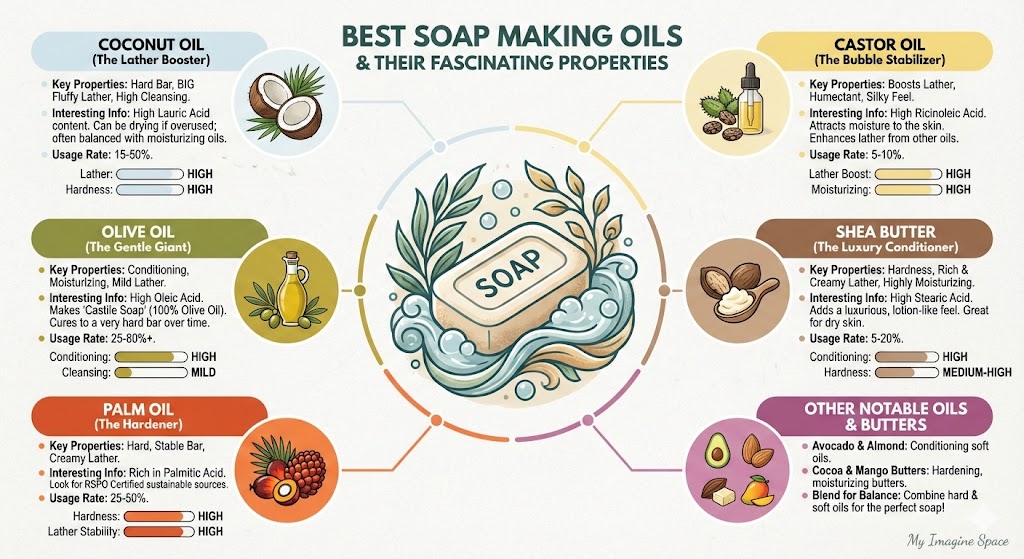
| The “Holy Trinity” | Coconut Oil (Cleansing, big bubbles), Sustainable Palm Oil (Hardness, stable lather), Olive Oil (Gentle conditioning). |
| Luxury Butters | Shea Butter (Unsaponifiables for moisture), Cocoa Butter (Hardness, chocolate scent), Mango Butter (Gentle hardness). |
| Conditioning Soft Oils | Sweet Almond Oil (Light, creamy), Avocado Oil (Vitamin-rich, penetrates skin), Rice Bran Oil (Great olive oil alternative). |
| Specialty Additives | Castor Oil (The bubble booster—essential), Jojoba Oil (liquid wax for longevity), Hemp Seed Oil (Silkiness). |
Key Techniques in Oil Formulation
- Reading Fatty Acid Profiles: Analyzing the percentage of Linoleic vs. Oleic acids to predict shelf life and skin feel.
- Heat Management: Melting hard butters like cocoa gently so they don’t become grainy upon cooling.
- The 30-30-30 Rule: A classic beginner formulation technique using 30% Coconut, 30% Palm, and 30% Olive oil (plus 10% specialty).
- Superfatting: Intentionally using less lye than required to leave 5-8% of your expensive luxury oils floating free in the bar.
- Infusing Oils: Soaking dried herbs like calendula or chamomile in your soft oils for weeks to extract medicinal properties.
- Preventing Rancidity: Adding Vitamin E or Rosemary Oleoresin Extract (ROE) to prolong the life of unstable oils.
- Substituting: Using a lye calculator to safely swap lard for palm oil or rice bran for olive oil.
- Trace Management: Knowing which oils accelerate the thickening process (like pomace olive) and which slow it down (like lard).
Be very careful with “grocery store” oils that come in clear plastic bottles; they often contain high amounts of cheap fillers or have been stored improperly, leading to Dreaded Orange Spots (DOS) in your finished soap just weeks after curing.
Skill Level and Learning Curve
| Skill Level | Focus Area | Time to Mastery |
|---|---|---|
| Beginner | Mastering the Coconut/Olive/Palm balance. | 1-2 months of batches |
| Intermediate | Swapping base oils, using Shea/Cocoa butters. | 6 months – 1 year |
| Advanced | Formulating without Palm; using high-end luxury oils. | Years of ongoing experiment |
Advantages and Challenges of Diverse Oils
The Benefits:
- Customizing a recipe for specific skin issues like eczema or acne is incredibly empowering.
- You can support sustainable agriculture by choosing fair-trade Shea or Rainforest Alliance certified Palm.
- Creating a high-end product for pennies on the dollar compared to luxury department store brands.
- The sensory experience of working with fragrant cocoa butter or rich, green avocado oil is therapeutic.
- You have total control over allergens—nut-free, vegan, or tallow-based options are all in your hands.
- Oil-based natural soaps are biodegradable and safer for our water systems than synthetic detergents.
The Challenges:
- High-quality oils fluctuate wildly in price; a drought in olive-growing regions can double your costs overnight.
- Shipping costs for heavy gallons of oil can be astronomical if you don’t have a local supplier.
- Storage is a headache; oils can go rancid if not kept cool and dark, ruining your investment.
- It takes months to test a new oil formulation since you must wait for the full cure to judge the results.
Have you ever wondered why handmade soap creates such a rich, creamy lather compared to the airy foam of commercial bars? It’s largely due to the natural castor oil and retained glycerin that commercial producers often remove.
Real Project Applications
One of my favorite oil-focused projects is the “Salt Bar.” This recipe uses roughly 80-100% Coconut Oil, which would normally be harsh, but uses a high superfat (20%) and is packed with sea salt. The salt creates a rock-hard bar that polishes the skin like a stone, while the coconut oil foams profusely even in salty water. It’s a spa experience in a bar and showcases the extreme capabilities of coconut oil.
Another classic application is the “Facial Bar” using Hemp and Tamanu oils. These oils are too expensive to use as a base, so I formulate a recipe with a stable base of Lard and Olive Oil, then add the expensive oils at “light trace.” This technique keeps the beneficial properties intact. The secret is consistent tension between cost and quality; you want the benefits of the luxury oil without washing your bank account down the drain.
For a baby shower gift, nothing beats a “Bastille” soap. Unlike pure Castile (100% olive) which is slimy, a Bastille bar uses 70% Olive Oil and 30% Coconut or Castor. This provides the gentleness needed for delicate skin but cures faster and lathers better than pure olive oil. I’ve made hundreds of these for friends, and they always ask for refills.
I once replaced all the water in my soap recipe with goat milk and used a high percentage of lard and almond oil. The resulting soap felt literally like washing with lotion and cured to a porcelain-white finish that looked stunning.
The Learning Experience
Learning to formulate your own oil blends is like learning a new language. At first, you rely on translators (recipes from books), but eventually, you start speaking fluently (writing your own recipes). My biggest hurdle was understanding “lodine” and “INS” values—numbers that predict hardness and conditioning. I used to ignore them until I made a batch of soft, oily soap that never hardened because my iodine value was too high.
Common mistakes often involve using too much “soft” oil, resulting in a bar that dissolves quickly in the shower. Beginners also tend to buy expensive oils like Argan or Rosehip and use them in wash-off products where their benefits are minimal. You learn quickly that some oils are for leave-on lotions, and others are for wash-off soaps.
The community is a lifesaver here. Soap making forums are filled with “oil charts” and substitution guides. I found a mentor early on who explained that tallow and palm oil are chemically very similar, which opened up a world of sustainable local sourcing for me.
“Your soap is only as good as your oil.” — A simple truth that reminds us that no amount of fragrance or color can fix a recipe built on poor-quality or rancid fats.
Comparison of Base Hard Oils
| Aspect | Palm Oil | Lard/Tallow | Shea Butter |
|---|---|---|---|
| Function | Provides structure and longevity. | Provides creamy lather and hardness. | Provides luxury conditioning and hardness. |
| Cost | Low to Medium. | Very Low (often free if rendered). | High. |
| Sustainability | Controversial (habitat loss concerns). | Sustainable (waste product). | Generally sustainable (often fair trade). |
| Vegan? | Yes. | No. | Yes. |
Common Questions from Fellow Crafters
Q: Can I make soap without coconut oil?
A: Yes, but you will struggle to get big bubbles. Babassu oil is a great alternative that works similarly to coconut oil but is gentler on the skin. You can also use palm kernel flakes.
Q: Why does my soap smell like crayons?
A: That is the distinct smell of rancid oils. It usually means your olive oil or canola oil was old before you even started, or the soap has been stored in a hot, humid place.
Q: Is it worth buying organic oils?
A: For wash-off products, generally no. The chemical reaction of saponification is violent and changes the oils molecularly. Unless it’s for marketing purposes, standard cosmetic-grade oils work perfectly.
Q: What can I substitute for Palm Oil?
A: If you want a vegan bar without palm, use a blend of Shea Butter and Cocoa Butter for hardness, or simply use animal fats like Lard if you aren’t strictly vegan. Be sure to recalculate your lye!
Q: How much Castor Oil should I use?
A: Keep it under 5-7%. While it boosts lather amazing well, using too much creates a sticky, tacky bar that feels unpleasant to hold.
Q: Can I use butter from the grocery store?
A: Do not use dairy butter! The milk solids will rot and smell terrible. You must use clarified butter (ghee) or stick to plant butters and rendered animal fats.

My Personal Results and Insights
| Oil Blend Type | Outcome |
|---|---|
| High Olive (Bastille) | Cure time: 8 weeks. Lather: Low/Creamy. Skin feel: Silky. |
| High Coconut (Salt Bar) | Cure time: 4 weeks. Lather: Explosive. Skin feel: Polish/Squeaky. |
| High Lard (Old Fashioned) | Cure time: 5 weeks. Lather: Dense/Creamy. Skin feel: Neutral/Gentle. |
| High Shea (Luxury) | Cure time: 6 weeks. Lather: Low/Lotion-like. Skin feel: Moisturizing. |
Never measure your oils by volume (cups/spoons). Oils have different densities; a cup of coconut oil does not weigh the same as a cup of olive oil. Using volume will lead to dangerous lye-heavy soap that can burn skin.
Final Thoughts and My Recommendation
Choosing the best soap making oils is a journey of personal preference and chemistry. After years of testing, I firmly believe that the “best” oil is the one that meets your specific needs. If you want a hard, long-lasting bar for a large family, Palm or Tallow are your best friends. If you want a vegan spa experience, invest in Shea and Avocado oils.
For beginners, I highly recommend starting with the classic triad: Coconut, Olive, and Palm (or Lard). This combination is forgiving, inexpensive, and produces a balanced bar that cleans and conditions. Don’t get distracted by the expensive exotic butters until you understand how the base oils behave.
Soap making is 90% preparation and 10% execution. Take the time to source fresh oils from reputable suppliers rather than clearing out the clearance rack at the grocery store. Your skin, and your finished product, will thank you for the investment in quality ingredients.